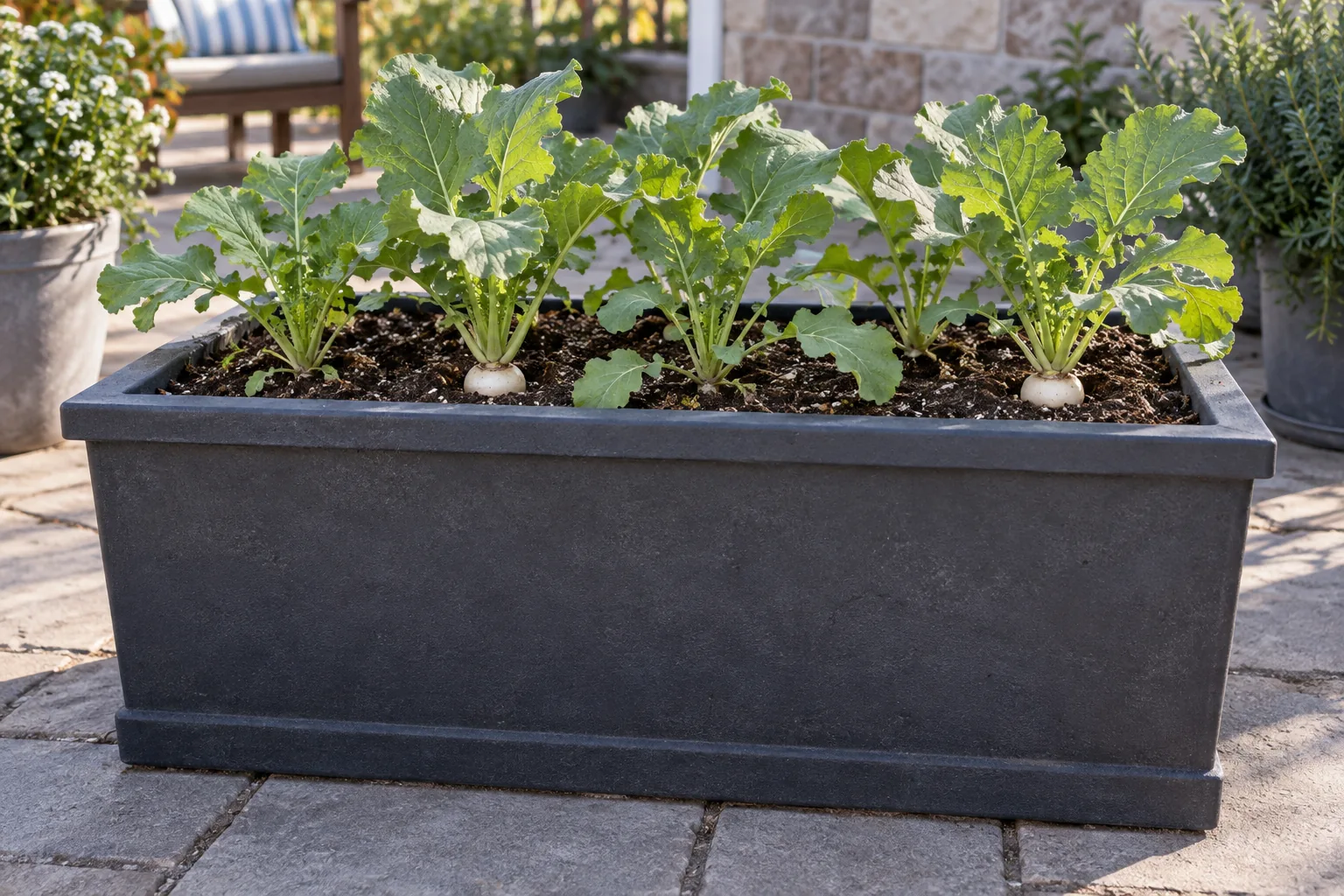
A container of turnips makes the most sense when you choose the harvest first: a few small roots, leafy greens, or a variety suitable for both. A broad pot gives small roots room to develop. Scattering a whole packet into it produces a thinning job, not a larger harvest.
Choose roots or greens before choosing seed
Illinois Extension distinguishes leaf-only selections from varieties grown for roots and greens. Read the packet’s harvest description and mature root size. A greens selection is a poor choice if your main goal is small round roots. Turnips and rutabagas are also different crops; do not substitute a rutabaga timetable for a quick turnip planting.
| Your goal | Plan for the container |
|---|---|
| A few small roots | Choose a variety intended for harvesting small. Measure final plant spacing and check roots as they approach the packet’s harvest size. |
| Repeated greens | Choose a greens or dual-purpose selection. Use its spacing guidance and keep the growing points intact when picking. |
| Roots plus a few leaves | Keep enough healthy foliage to support root growth. A heavy leaf harvest competes with the root goal. |
| Large storage roots | Check the variety’s larger spacing and growing period; a small patio pot may be a poor fit. |
Use a broad container with usable root space
The Royal Horticultural Society recommends a container at least 16 inches wide for small or mini turnips, thinning to about 4 inches apart for that purpose. Its UK “multi-purpose compost” means a prepared growing medium, not a pot filled with homemade garden compost. Use mix intended for container growing.
Width alone does not settle the choice. Maryland Extension advises checking both depth and total volume against the crop’s roots and top growth. Use a deep planter with room below the intended root; reject shallow ornamental bowls. For a new purchase, confirm suitable depth against the variety or supplier’s container guidance rather than treating one rim diameter as a complete specification.
Inspect drainage openings before filling. Set the planter where water can escape and where you can reach every plant. An outer cover or saucer must not hold water against the pot. Measure the usable interior, not the widest outside lip, when marking positions.
Mark a small-root layout before sowing
For an illustrative 16-inch-square usable planting area, a conservative nine-position layout has centers at 4, 8 and 12 inches in each direction. That gives three rows of three positions, with 4 inches between neighboring centers and a 4-inch edge margin. It is a layout example for a small-root crop, not a yield forecast or a claim that every variety belongs at that spacing. Wider packet spacing takes precedence.
- Choose a sunny site and a locally suitable cool-season planting window.
- Fill and moisten the potting mix, leaving watering room below the rim.
- Mark the final spacing so you know which seedlings to retain.
- Sow directly in the growing container at the packet’s depth. Utah State gives a general depth of ¼–½ inch for turnips.
- Keep the seedbed moist through emergence, then thin crowded seedlings to the chosen spacing.
Utah State Extension recommends direct seeding and consistent moisture. Avoid deep cultivation around the swelling roots. Its guidance links uneven moisture with cracking and poor root quality; apply that principle by checking the container, not by converting an in-ground weekly irrigation figure into a fixed pot dose.
Use the season in your location
Turnips are a cool-season crop. In northern areas, a new October sowing may have too little useful growing time for roots; in mild-winter areas, local fall and winter planting windows can differ greatly. Read your county extension calendar alongside the seed packet. The stated days to maturity are a planning estimate, not a promise under short days, cold weather or limited light.
Write the sowing date and intended harvest size on a label. Before a cold spell, assess protection and harvest options. Frost tolerance is not unlimited winter storage in an exposed container. Do not wait for a large root merely because the picture on a packet shows one.
Check one root before harvesting the whole pot
Illinois describes 2–3 inches in diameter as a useful general turnip harvest range, while mini-root varieties may be picked smaller according to their packet. When a root reaches the intended size, lift one and check its condition and kitchen usefulness. Record the size and date before deciding whether the others need longer.
If the crop is mainly for roots, avoid stripping its leaves. If it is for greens, Illinois advises leaving the growing points so tops can regrow. Keep the two goals separate in your notes. For a different small root crop, compare radishes in pots instead of crowding both into a container already at its planned capacity.
Your next steps
0 of 5 steps checked · Saved on this device
Sources & further reading
Extension resources support the growing principles in this guide. Planning examples apply them to small container gardens. Local conditions and variety instructions take priority.
- RHS: container turnips and small-root spacing
- Utah State Extension: turnip sowing and moisture
- Illinois Extension: varieties and harvesting turnips
- Maryland Extension: container volume, depth and drainage
Prepared with AI assistance; this is research-based guidance, not a personal growing trial. Editorial policy · Suggest a correction