
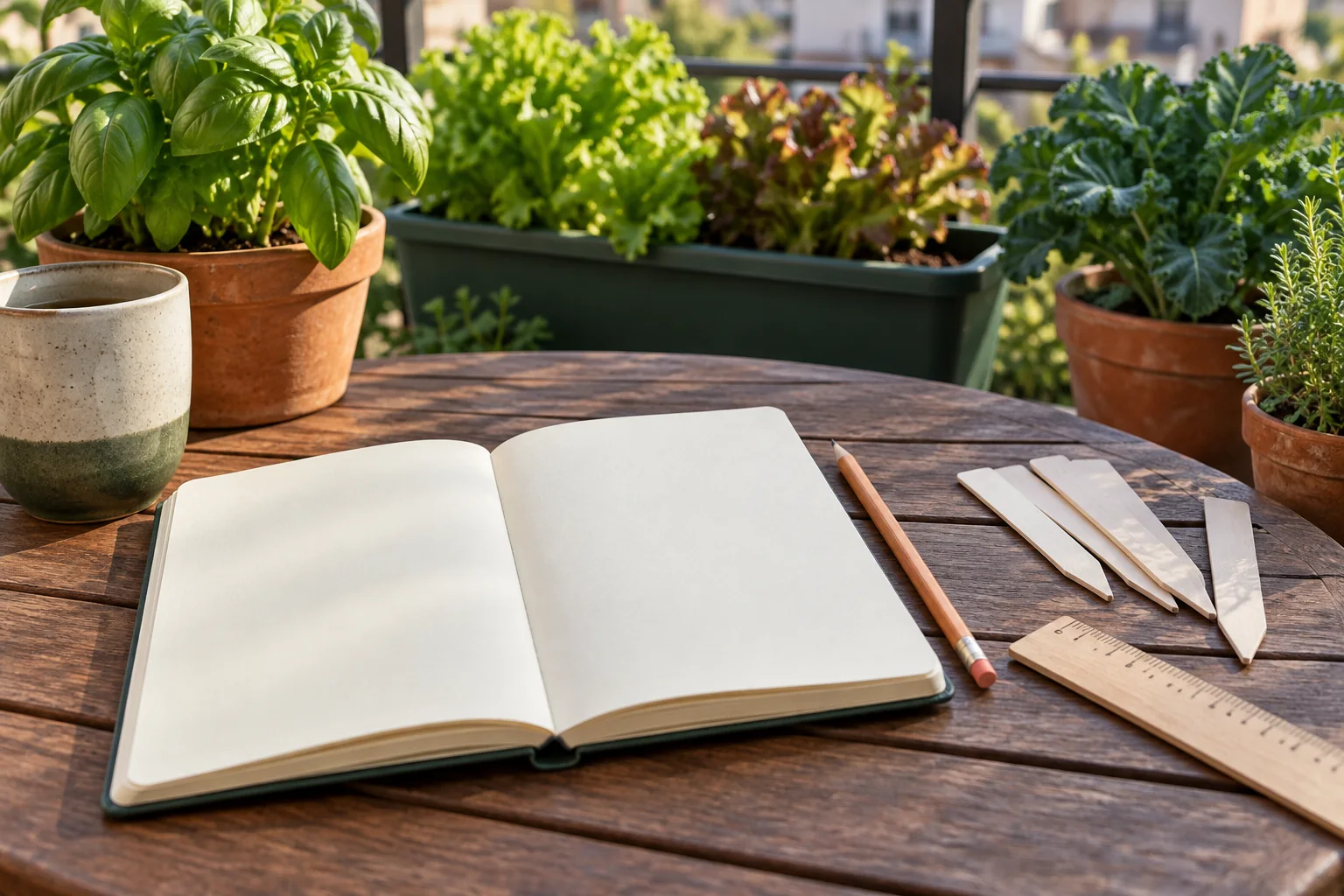
A garden record earns its space when it answers the next practical question: should this crop get the same pot again? You do not need to reconstruct every watering. Start with the containers you have now, record what you actually observe, and leave clear notes for your next planting decision.
Give every container a stable name
Use a simple identifier such as “P1” on a plant tag and in the record. Keep that identifier when the pot moves or its crop changes. “The basil beside the door” becomes confusing once three pots trade places. A small sketch with the pot names connects the notes to the real layout without requiring a measured drawing of the entire balcony.
Penn State’s garden-journal guidance recommends a format you will use consistently, whether paper or digital. A notebook, a note on your phone or a basic spreadsheet can all hold the same information. Save the plant label or seed-packet photo alongside the entry; guessing a cultivar name later weakens the comparison.
| Record field | What to put there |
|---|---|
| Container and location | Pot ID, usable inside dimensions, drainage arrangement and current position. |
| Crop and start | Crop, cultivar, seed or transplant, and the actual sowing or planting date. |
| Conditions observed | Date, sunlight observation, relevant weather and how moist the mix felt when checked. |
| Action taken | Watering, measured fertilizer application, moving the pot or a specific pest response. |
| Harvest used | Date and a consistent unit: grams, stalks, fruit count or a clearly described kitchen portion. |
| Next decision | Repeat, change one part of the setup, pause, or seek identification before planting again. |
Write at decision points, not only on perfect days
Illinois Extension suggests choosing a journaling schedule that fits your routine and recording planting, flowering and harvest dates. For a few containers, add a note when something changes: a transplant arrives, the pot moves, you apply fertilizer, the first usable leaves are cut, or a problem appears. A brief regular check-in can catch the ordinary weeks between those events.
Keep observation separate from explanation. “Mix wet at the last two checks; lower leaves yellow” is an observation. “Too much fertilizer” is a possible explanation that still needs investigation. If you use the feeding record, copy the product and actual dose. If light seems limited, use the sunlight worksheet rather than writing only “sunny.”
Note where weather information came from. Rain at a nearby weather station does not prove that a covered balcony pot received water. “Rain reported nearby; pot under roof stayed dry” preserves that distinction. When there is no reliable measurement, a plain description is better than an invented number.
Use photographs that can be compared
Penn State describes photographs as a way to track a vegetable garden’s progress. Take a whole-pot view and, when needed, a closer view of the feature you want to follow. Include the pot ID in the filename or note. Similar framing makes changes easier to see; a beautiful close-up of one leaf cannot show the full plant’s condition.
For a problem, keep the date and record what changed before and after the photo. Avoid using a stock or generated illustration as if it were a picture of your plant. The notebook image on this page is an illustration, not evidence of a real harvest. Illinois Extension’s account of nature journaling also emphasizes observations, measurements and questions; a question mark is a useful part of a record when identification is uncertain.
Total one useful measure without turning it into a promise
Illustrative example, not a site trial: suppose one pot supplied three usable lettuce harvests weighing 150, 90 and 60 grams. The recorded total would be 300 grams. At 50 grams per planned salad portion, that equals six portions. It does not tell you that another pot will produce the same amount or that the next harvest will arrive on a particular day.
Keep weights and counts in separate columns or lines. Five tomatoes plus 40 grams of thyme is not a meaningful combined harvest total. Record what was usable and what was discarded if reducing waste matters to you. If you did not weigh a harvest, write “used a handful in soup” rather than assigning it a precise weight afterward.
Finish each crop with one next action
- Repeat: the crop was useful, you liked eating it and its care fit your routine. Save the variety and setup details.
- Change: identify one practical adjustment to try, such as spacing or a different location, and explain why.
- Pause: the plant demanded more space or attention than you want to give it. The pot can serve a different crop.
- Investigate: recurring symptoms need identification before you reuse the mix or repeat the same setup.
These are personal planning decisions, not a controlled comparison of varieties. Different weather, plant age and care can explain differences between pots. Use the mix-reuse guide for material decisions and the seasonal planning guide for timing. In mild regions, keep adding entries as crops continue; a journal does not need an October shutdown date.
End with one sentence you can act on when ordering seeds or moving pots. A small record you can find next season is more useful than a detailed template that remained empty.
Your next steps
0 of 5 steps checked · Saved on this device
Sources & further reading
Extension resources support the growing principles in this guide. Planning examples apply them to small container gardens. Local conditions and variety instructions take priority.
- Penn State Extension: keeping a garden journal
- Illinois Extension: practical garden records
- Penn State Extension: garden photography
- Illinois Extension: observing and recording the natural world
Prepared with AI assistance; this is research-based guidance, not a personal growing trial. Editorial policy · Suggest a correction