When several seedlings emerge together, decide which plants will stay before their roots become a crowded tangle. Thinning removes extras; transplanting moves a plant into another growing space. You do not have to rescue every sprout to raise the small number of healthy plants your containers can hold.
Identify the crop and the job first
Find the crop label and the final plant spacing on the packet. Use the packet-reading guide if the sowing and thinning instructions are easy to confuse. The final count depends on whether you are raising individual transplants, a root crop or a deliberately dense young-leaf crop. Do not apply “one per cell” to every container planting.
| Situation | What thinning is trying to achieve |
|---|---|
| Several tomato, pepper or cabbage seedlings in one nursery cell | Retain a suitable individual transplant where the crop is being raised one plant per cell. |
| A row of carrots in its final pot | Leave crop-appropriate space between retained roots without disturbing them. |
| A baby-leaf planting | Use the packet’s young-leaf spacing and planned harvest stage. |
| A planned microgreen tray | Follow a microgreen growing and harvest method; dense sowing is intentional. |
Maryland Extension distinguishes seed leaves from true leaves: the earliest leaves are usually simpler, while the next leaves begin to resemble the mature plant. Its microgreen guide describes intentional dense production harvested young. That is a separate method from keeping a crowded nursery cell until every plant reaches maturity. See the first-tray guide for that project.
Thin individual nursery cells at the right stage
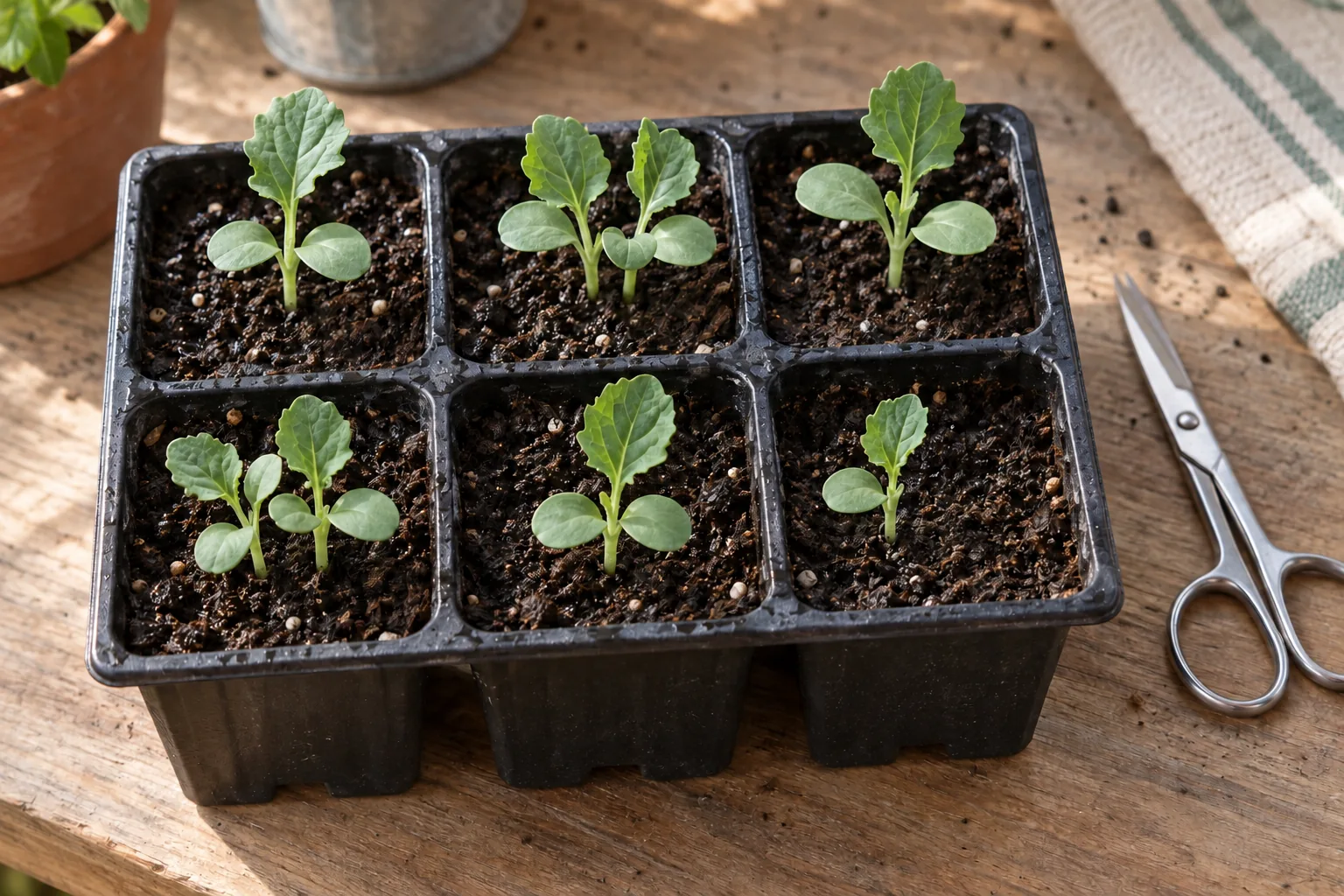
Minnesota Extension recommends thinning multiple seedlings in a cell after true leaves develop, keeping the healthiest plant and cutting the extras at the growing-medium surface. Pulling or separating them can damage the retained seedling’s roots. This advice fits a nursery cell intended to hold one transplant; use crop-specific instructions when the planting method intentionally retains a clump.
- Put the tray where the stem bases are easy to see. Identify the seedling you will retain before cutting.
- Choose a healthy, sturdy plant in a useful position. The tallest seedling is not automatically the best; inspect its stem and leaves.
- Use clean small scissors to cut the unwanted seedling at the mix surface, keeping the blade away from the retained stem.
- Lift away the severed top without tugging the remaining plant. Work through the tray one cell at a time.
- Count retained plants and record empty cells before deciding whether to sow replacements.
Illustrative tray count: six cells contain 2, 3, 1, 0, 2 and 1 emerged seedlings. That is 9 seedlings in 5 occupied cells. If all occupied cells contain a healthy candidate and the plan is one per cell, retain 5 and remove 4 extras. The empty cell is still empty; thinning cannot turn it into a sixth transplant. This calculation is a planning example, not an expected germination result.
Handle carrots in their final pot differently
Maryland’s carrot guide recommends cutting extras instead of pulling to limit root disturbance, and describes thinning when plants are about 2 inches tall. Its spacing ranges vary with the growing instructions, so use your variety’s final spacing and root size to lay out the pot. See the container-carrot guide for matching the root to usable depth.
For a simple measured-row example, a variety that calls for 3-inch final spacing could have centers at 1.5, 4.5, 7.5 and 10.5 inches along a 12-inch usable row. Each neighboring pair is 3 inches apart. That shows how to measure centers; it is not a universal carrot spacing or permission to ignore container depth, width and the packet. Mark the intended keepers before snipping the crowded areas between them.
Decide whether saving extras is worth the space
If you want more transplants, plan extra cells from the start using the small-batch seed guide. Separating tightly crowded plants solely to avoid discarding a sprout adds handling and requires suitable pots, light and later planting space. For a one-plant cell, cutting the extras is a simple way to protect the plant you actually need. Do not move unwanted carrot seedlings as the default solution; they were sown in their final root-growing space.
After thinning, continue checking moisture and light. Removing competitors does not fix weak lighting; use the leggy-seedling checks if stems are stretched. Do not add a strong fertilizer dose to compensate for the plants you removed. Note the retained count, thinning date and the next observation in your garden record.
Treat collapsed stems as a separate problem
Minnesota’s damping-off guide describes soft, water-soaked or threadlike stem damage in affected seedlings. Those signs need a health assessment, not simply a wider spacing plan. Clean tools and containers, appropriate drainage and clean starting mix matter for prevention. If several plants collapse, record the symptoms and seek local extension help instead of repeatedly rearranging the tray. Thinning is a spacing task, not a cure for disease.
Your next steps
0 of 5 steps checked · Saved on this device
Sources & further reading
Extension resources support the growing principles in this guide. Planning examples apply them to small container gardens. Local conditions and variety instructions take priority.
- Minnesota Extension: thinning and raising seedlings
- Maryland Extension: carrot thinning and root disturbance
- Maryland Extension: seed leaves, true leaves and microgreens
- Minnesota Extension: damping-off symptoms and prevention
Prepared with AI assistance; this is research-based guidance, not a personal growing trial. Editorial policy · Suggest a correction