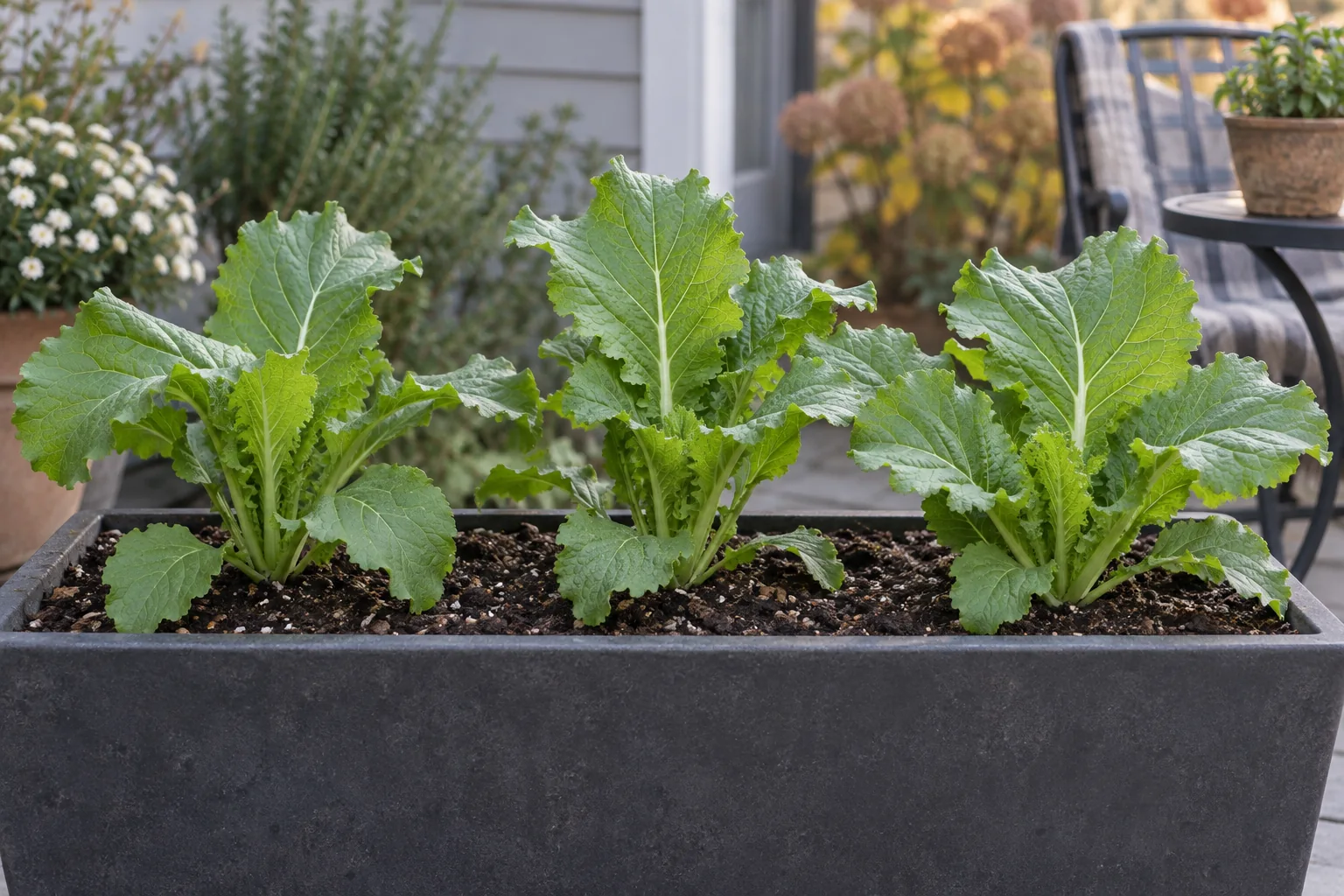
Mustard greens let you choose between small peppery leaves and larger cooking greens. Decide which harvest you want before filling the pot: a closely sown baby-leaf crop and several full-sized plants need different space. Start with one named variety so you can learn its flavor and growth habit.
Choose the harvest before the layout
| Your goal | Plan the container around it |
|---|---|
| Young leaves for a mixed salad | Use a variety intended for baby-leaf harvest and its packet spacing. Pick while leaves are tender. |
| Larger leaves for cooking | Allow the variety’s mature spacing and keep individual plant centers accessible. |
| A first trial with an unfamiliar variety | Sow one small batch and record the eating stage you prefer before committing every planter. |
Mustards include smooth, curled, green and red-leaved varieties. Utah State lists Florida Broadleaf, Green Wave, Giant Curled and Giant Red among examples. These names are starting points for reading descriptions, not a promise that each fits the same pot or tastes identical. Keep the packet rather than relying on a generic “greens” label.
Check width as well as soil volume
Maryland Extension includes mustard greens among small vegetables with a general container range of 1–3 gallons and 4–6 inches of growing-medium depth. That broad category is not a plant-count formula for a giant mustard cultivar. A deeper, wider planter gives more room to work, but its usable surface must still fit the chosen spacing.
The RHS recommends containers at least 12 inches wide for salad-leaf sowings because small pots dry more quickly. Use prepared container mix and an open drainage outlet. Check the inside dimensions below the lip, then mark the intended plant positions. A tall narrow pot can hold considerable mix while offering little room for several leaf rosettes.
Avoid adding a bottom layer of gravel; Maryland explains that it does not improve drainage. Keep outlets clear and empty water collected in a saucer. See the drainage guide and container sizing if you are choosing between pots already on hand.
Sow for your local cool season
Mustard prefers a sunny site and cool growing weather. Utah State places best growth below about 75°F and warns that heat can reduce quality and encourage flowering. An October date is not enough information: northern gardeners may have little outdoor growing time left, while some mild-winter areas have a useful planting window. Check your local extension calendar and the packet’s maturity guidance.
- Moisten the mix and label the variety, sowing date and intended harvest.
- Sow at the packet depth; Utah State gives ½ inch as general mustard guidance.
- Keep the seed zone moist and watch for emergence.
- Thin to the packet’s spacing for the chosen harvest stage.
- Check the forecast and plan protection or an earlier harvest before damaging cold.
Utah State gives 3 inches between mustard plants in rows, but cultivar directions may call for more room. Do not treat that row spacing as a universal square-grid pattern for mature giants. Thin surplus seedlings before crowding prevents you from reaching the mix. The useful measure is the space each remaining plant has, not how many seeds germinated.
Keep growth steady without overfilling the pot
Check container moisture regularly. The RHS notes that salad plants in pots are especially vulnerable to drying; watering in the morning helps plants through the day and avoids unnecessarily wet surfaces overnight. Direct water toward the mix, let excess escape, and do not let a missed morning check become a reason to leave a thirsty plant dry until tomorrow.
For feeding, check whether the mix already contains fertilizer and how long it is intended to supply nutrients. Avoid automatically applying an in-ground fertilizer dose to a small container. Use the container fertilizer guide if feeding is needed. A short baby-leaf crop and repeated harvests from larger plants are different management situations.
Pick the outer leaves and judge the next batch
For repeated picking, take a few suitable outer leaves while leaving the growing center intact. The RHS describes this approach for salad leaves. Keep harvesting tools clear of the central shoots. Mustard has a naturally assertive flavor; record whether you preferred the younger leaves or larger cooked ones rather than assuming a stronger taste always means a problem.
Inspect chewed leaves before choosing a treatment. For suspected night feeding, use the slug inspection guide. Photograph the plant and note new damage. At the end of the batch, record variety, spacing, weather and harvest stage; those observations make the next sowing more useful than simply adding more plants.
Your next steps
0 of 5 steps checked · Saved on this device
Sources & further reading
Extension resources support the growing principles in this guide. Planning examples apply them to small container gardens. Local conditions and variety instructions take priority.
- Utah State Extension: mustard growing and harvest
- Maryland Extension: vegetable container dimensions
- RHS: salad leaves in containers
Prepared with AI assistance; this is research-based guidance, not a personal growing trial. Editorial policy · Suggest a correction