
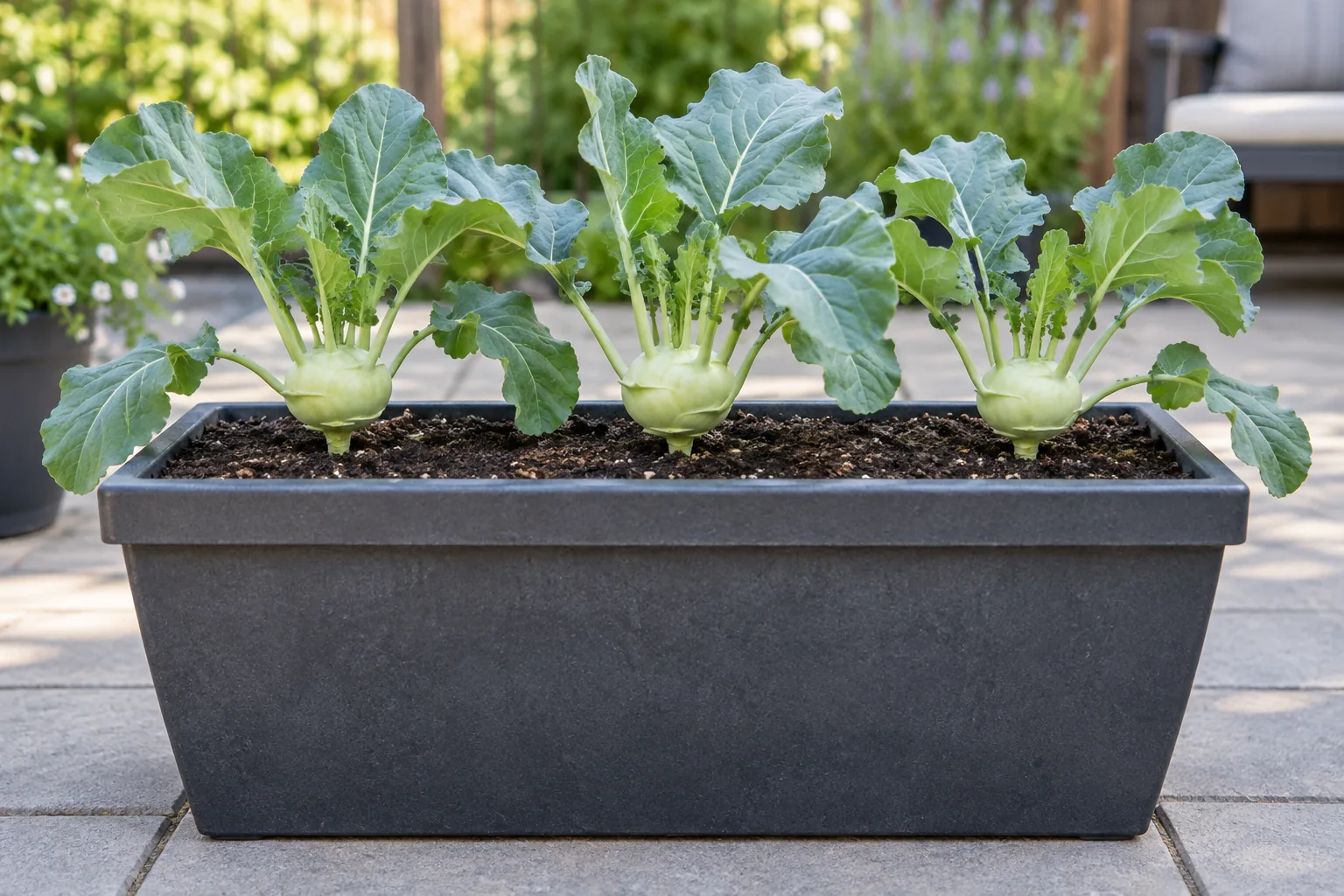
Kohlrabi is a useful choice when you want a few crisp vegetables from a cool-season container. Its round edible swelling is an enlarged stem above the soil, not a root to bury. Give each plant its own space and pick ordinary varieties while small rather than waiting for a giant harvest from a crowded pot.
Choose an ordinary or giant variety deliberately
Minnesota Extension describes both ordinary and giant kohlrabi. Ordinary types are commonly harvested at 2–3 inches across; giant selections have different size and spacing targets. Read the packet before buying. Purple and green skins do not by themselves tell you the correct mature size. For a first small container, an ordinary variety keeps the harvest decision simpler.
Do not pile mix around the swelling to hide it. When transplanting, Minnesota recommends keeping the plant at the same level it occupied in its nursery pot. Label the variety and intended harvest diameter so you can check the actual stem, not just count days.
Check depth, volume and planting area
Maryland Extension groups cole crops with medium vegetables and gives a general starting range of 4–6 gallons of growing medium and 8–12 inches of depth. This is broad container guidance, not a tested kohlrabi plant-count formula. Choose a sufficiently deep, draining planter and then check its usable surface against the variety’s spacing. A tall narrow bucket and a broad trough with equal volume offer different planting layouts.
Use mix made for containers and keep drainage openings clear. Do not sacrifice root space to a layer of rocks. Empty collected water from a saucer after watering. Measure the inside planting area below the lip rather than using the container’s outer decorative dimensions.
Mark plant centers before sowing
Utah State recommends 6 inches between kohlrabi plants in a row, with 12 inches between rows. Minnesota gives 4 inches for ordinary types and 12 inches for giants. The difference is a reason to use the chosen variety’s directions, not to average all spacings together. A 6-inch single-row plan is a manageable starting example for ordinary plants when the packet permits it.
| Usable trough length | Illustrative single-row layout |
|---|---|
| 18 inches | Two centers at 6 and 12 inches: 6 inches apart with 6-inch end margins. |
| 24 inches | Three centers at 6, 12 and 18 inches: 6 inches apart with 6-inch end margins. |
| Giant variety or wider packet spacing | Redraw the layout using that spacing; do not fit it into the ordinary-type example. |
Illinois Extension emphasizes individual plant space and rooting depth when setting container density. Draw the positions on paper before filling a new planter. If the chosen pot cannot fit them comfortably, reduce the plant count. More seeds can produce more seedlings to thin, but they cannot create more growing space.
Sow for your local cool season
- Check the local extension planting calendar and the variety’s maturity information.
- Choose a sunny site and moisten the mix before sowing.
- Sow ¼–½ inch deep, following the packet if it gives more specific directions.
- Keep the seed zone moist through emergence.
- Thin to the final positions, or transplant suitable starts at their existing soil level.
Kohlrabi quality suffers in hot weather. Utah State links moisture fluctuations with woody stems, so check the pot regularly and water as needed rather than translating its in-ground irrigation figures into a fixed weekly dose. Use the seedling-thinning guide if several plants occupy one position.
For U.S. readers, “fall crop” does not mean sowing anywhere in October. Northern locations may have too little growing time left; mild-winter areas may have a different planting window. Read days to maturity as an estimate alongside local temperature and daylight conditions. Young plants can be damaged by hard frost, and cold exposure can also affect flowering. Check protection or harvest options before a cold spell.
Check the stem before it outgrows the eating stage
For ordinary varieties, begin checking as stems approach 2 inches across and use the packet’s harvest range. Cut the stem below the swelling when ready; peel the tough outer skin before preparing the interior. The young leaves are also edible. Giant varieties require their own harvest target. Do not keep an ordinary stem growing simply because the leaves still look healthy.
Record the harvest diameter, planting date and texture in your notes. That gives you a useful comparison for the next sowing. If the planter feels too crowded to inspect each stem, reduce the count next time rather than assuming a larger fertilizer dose will solve the layout.
Your next steps
0 of 5 steps checked · Saved on this device
Sources & further reading
Extension resources support the growing principles in this guide. Planning examples apply them to small container gardens. Local conditions and variety instructions take priority.
- Minnesota Extension: ordinary and giant kohlrabi
- Utah State Extension: sowing, spacing and harvest
- Maryland Extension: container depth and volume
- Illinois Extension: container plant density
Prepared with AI assistance; this is research-based guidance, not a personal growing trial. Editorial policy · Suggest a correction