A pot of green onions is a useful project when you want a few fresh stalks for a meal rather than a sack of storage bulbs. Start by choosing your planting material, then leave enough room to tend and harvest it. A narrow planter can hold a manageable row, but it cannot promise an endless supply of onions.
Choose the crop before buying the planting material
“Green onion” describes how an onion is used as well as how it grows. Bunching-onion seed and young bulb onions can both supply green stalks, but their long-term growth differs. Illinois Extension distinguishes green onions from mature storage onions. For this project, plan to use the plants young; do not apply bulb-curing instructions to a fresh bunch for dinner.
| Starting material | What to plan for |
|---|---|
| Seed labeled bunching onion or scallion | Follow that variety’s sowing depth and germination instructions. Allow time for seedlings to establish. |
| Young onion transplants | Check whether the variety is intended for bunching or bulb production; this plan harvests it green. |
| Small dormant onion bulbs sold as sets | Use planting sets, not chopped cooking onions. Sets establish quickly, but are not the same as seed. |
Illinois describes firm, dormant sets as a straightforward way to raise green onions. Its set-planting guidance uses a depth of 1½ inches for that purpose. That depth belongs to sets; do not bury tiny onion seed 1½ inches deep. Seed and transplant directions come from the corresponding packet or supplier.
Measure the usable pot and the row
Oregon State’s bunching-onion guide calls for a container at least six inches deep with drainage. Leave watering space above the mix rather than filling to the rim. A deeper pot offers more room for mix, but the interior planting area still controls how many positions fit. Use a container potting mix and keep the drainage holes open; see the mix guide.
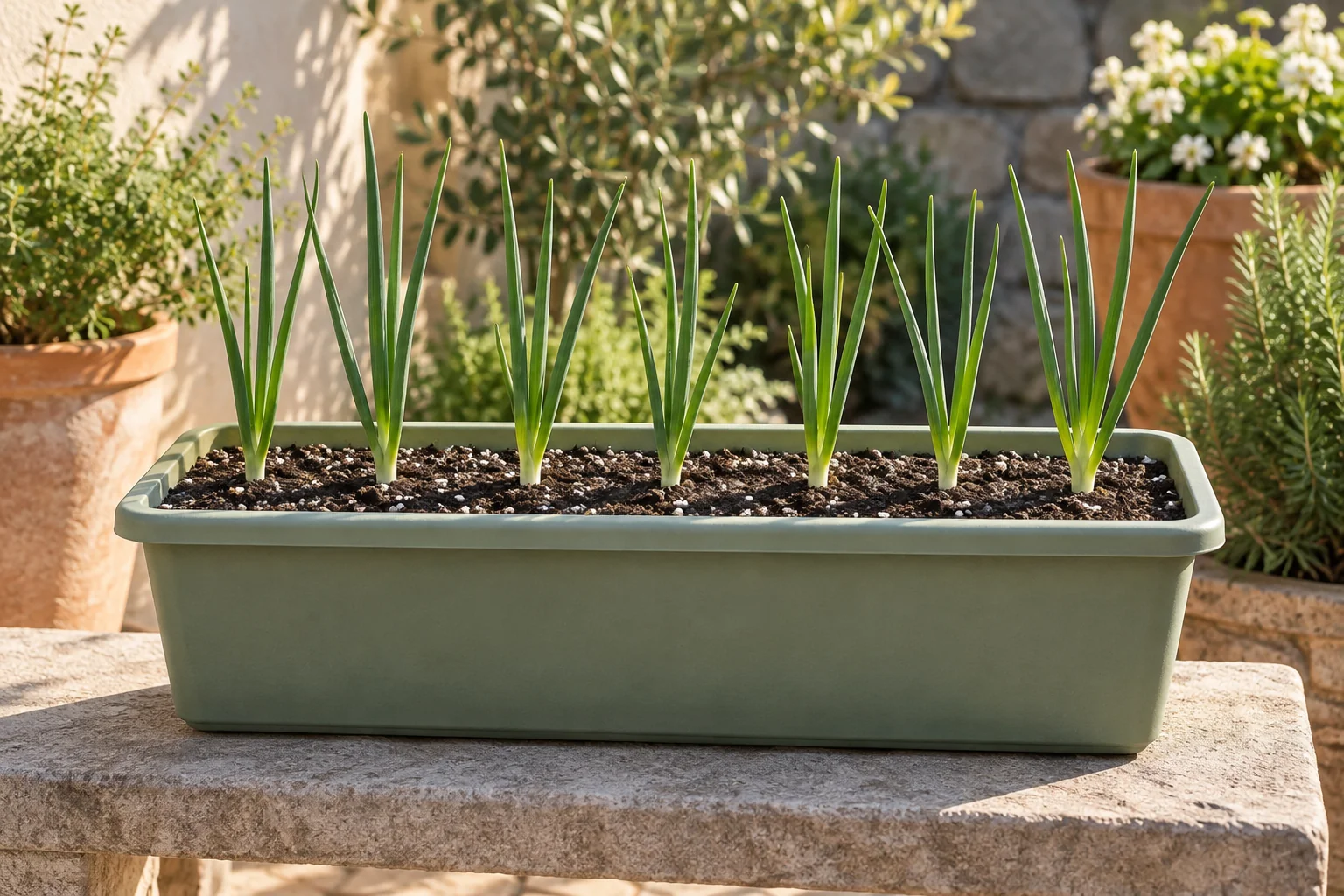
Virginia Cooperative Extension’s container table gives green onions two to three inches between plants. For a first small row, using the roomy end makes each plant easier to inspect and harvest. A planter with an inside length of 24 inches can hold eight positions at 1½, 4½, 7½, 10½, 13½, 16½, 19½ and 22½ inches. That gives seven three-inch gaps and 1½-inch end margins. This is a single-row layout example, not a tested yield or the maximum capacity of every box.
Check usable depth separately from the row length; a false bottom or water reservoir reduces the space for roots. Start with one row if access is limited. Mark the positions before sowing or planting, and thin seedlings to your chosen spacing rather than letting every germinated seed become a crowded clump. The pot-size guide explains why rim width and nominal gallons are different measurements.
Use local weather, not an October deadline
Illinois advises planting container vegetables at the appropriate garden season and following the seed packet. In much of the northern U.S., October may be too late to start an outdoor batch for a useful fall harvest. Milder regions have different planting windows. Check your local extension calendar, remaining warmth and actual light before filling another pot; the fall planning guide helps organize that decision.
Oregon State uses a soil temperature of at least 50°F for outdoor bunching-onion seed sowing. That is a starting condition, not proof that a crop will finish before winter. A sunny indoor position is another option, but measure the light there; a bright-looking room can be a poor growing space. Compare the location with your sunlight observations and budget for supplemental light only if needed.
Keep moisture steady and harvest for the meal
Check the mix regularly and water gently when needed, letting excess drain. Small containers can dry quickly; cool indoor pots may stay wet longer. Do not copy a fixed daily volume from another pot. Read the mix’s fertilizer label before adding anything, and use the feeding record to avoid duplicate applications.
Oregon State says harvesting can begin once plants are about six inches high. For whole stalks, loosen the mix and lift carefully so neighboring plants stay rooted. Leaf cutting can give further growth during suitable growing conditions, but it is not a guarantee of unlimited regrowth. Harvest what you will use, rinse and dry it, and refrigerate; Oregon State suggests about a week for fresh bunching onions.
Keep a short record of planting material, sowing date, first harvest and stalks actually used. Eight planted positions are not automatically eight successful harvests. If you need two stalks per recipe, eight harvested stalks would cover four recipes; use that arithmetic to plan the next batch after you know how the first one grew.
Your next steps
0 of 5 steps checked · Saved on this device
Sources & further reading
Extension resources support the growing principles in this guide. Planning examples apply them to small container gardens. Local conditions and variety instructions take priority.
- Oregon State: bunching onions
- Virginia Cooperative Extension: vegetables in containers
- Illinois Extension: onions and planting sets
- Illinois Extension: planting container vegetables
Prepared with AI assistance; this is research-based guidance, not a personal growing trial. Editorial policy · Suggest a correction