
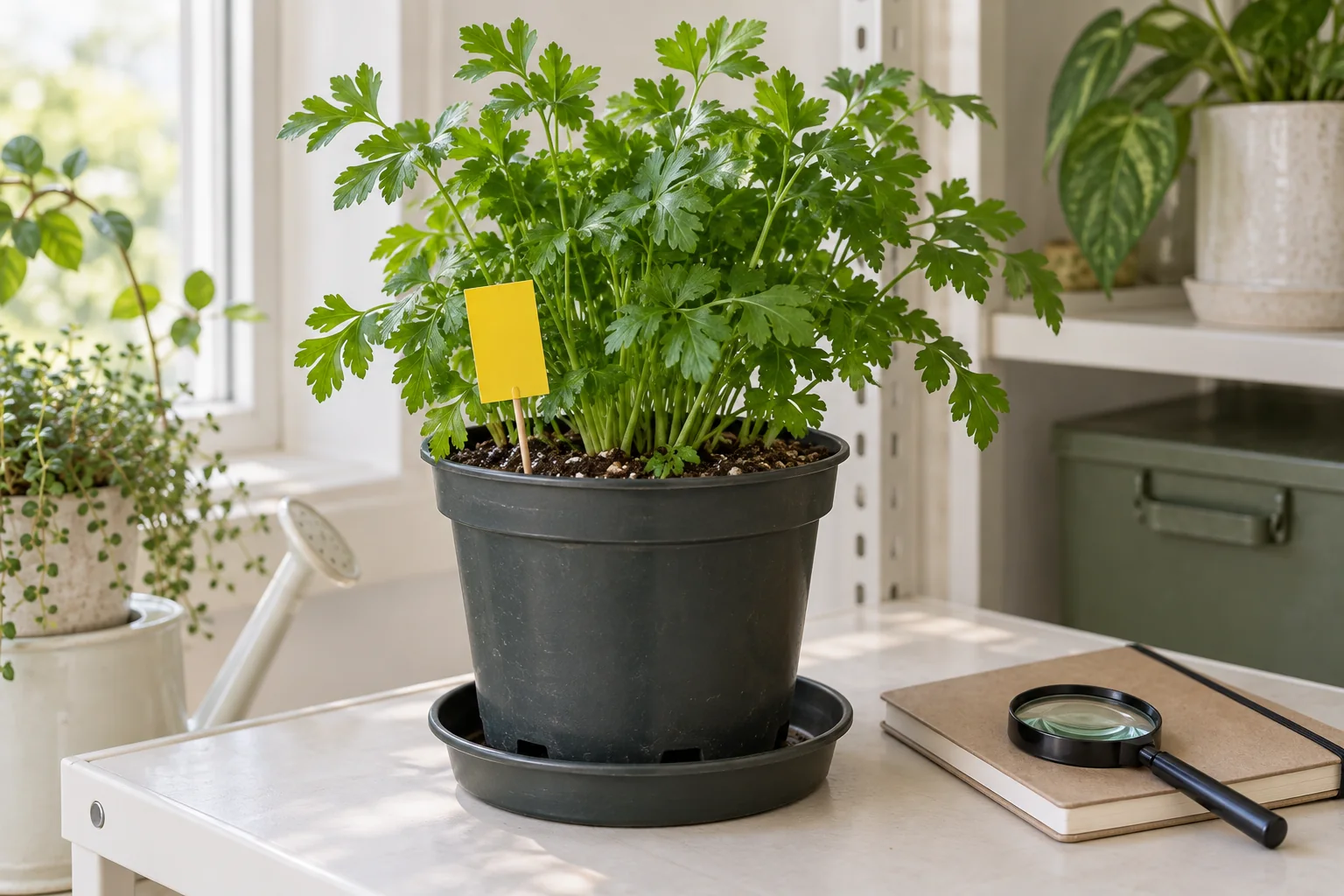
Tiny flies near an indoor herb pot are a reason to inspect the pot, not to spray the kitchen. First work out whether the insects are fungus gnats and which containers they are associated with. Then address the growing conditions while recording what changes. A sticky card full of adults does not tell you how many larvae remain in the mix.
Identify the insect before choosing a response
UC Integrated Pest Management describes adult fungus gnats as delicate, dark, mosquito-like flies with slender legs and long antennae, commonly about 1/16–1/8 inch long. They often rest or run near potting mix and are relatively weak fliers. Their pale, legless larvae have a dark head. Use the Minnesota diagnostic photographs to compare actual features; our generated herb-and-card illustration is not an insect identification photograph.
Note where you see activity: near the mix, at a fruit bowl, around a drain, or at a window. Those locations are clues, not a confirmed identification. Minnesota warns that fungus gnats can be confused with other small flies. Photograph an insect beside a size reference or save a clear trap image for an extension identification request.
| Observation | Useful next check |
|---|---|
| Small flies rise from a pot when it is disturbed | Look closely at the insects and the moisture/debris in that particular pot. |
| Flies collect on a yellow card | Compare their features with a diagnostic reference. Other flying pests can be caught too. |
| The plant wilts while the mix stays wet | Check drainage and root condition; do not assume either thirst or gnat damage. |
| Activity is mainly away from plants | Inspect the associated location and seek identification before treating the growing medium. |
Track adults without confusing trapping with control
Minnesota recommends yellow sticky cards for detecting adults, while cautioning that cards alone are not enough for management. Put one close to the suspected pot as directed by its maker, clear of harvestable leaves and where it will not catch fingers or pets. Keep its position consistent while comparing counts.
Give each pot a short name and date each card. At a regular inspection, write the number of new captures since the previous check. If you replace a card, start a new count. Comparing seven days on an old card with one day on a new card can create an apparent change that says little about the insects.
For example, suppose a card holds four insects on Monday and seven on Wednesday: that is three additional captures over two days, not seven new insects on Wednesday. This is a recordkeeping example, not a treatment threshold or a result from our garden. Keep identification notes alongside the numbers.
Correct excess moisture without drought-stressing the herb
UC IPM emphasizes excess moisture and organic debris because immature stages live in the growing medium. Adult gnats are mainly a nuisance; large larval populations can damage roots, especially on young plants. UC also notes that watering and root-health problems are more common explanations for wilt than gnat damage.
- Remove fallen leaves and other decaying debris from the mix surface and surrounding shelf.
- Confirm the pot can drain. Empty accumulated runoff rather than leaving its base standing in water.
- Check actual moisture before watering. Let the surface dry as far as the herb can tolerate without wilting; do not impose the same dry interval on every crop.
- Keep inspecting nearby pots. A clean card beside one container does not establish that the whole shelf is clear.
The moisture limit follows Minnesota’s guidance to avoid wilting while reducing wet surface conditions. A newly sown tray and an established rosemary plant have different needs. If the same mix stays soggy for days, review the watering method and drainage arrangement instead of repeatedly withholding water until the plant collapses.
Escalate carefully around edible crops
UC IPM lists biological options that target larvae, including Bacillus thuringiensis subspecies israelensis (Bti). That name alone is not a use instruction. Before applying any product, confirm its current label allows the particular edible crop, indoor location and application method. Follow its dose, interval and harvest restrictions; do not transfer an ornamental-houseplant treatment onto kitchen herbs by analogy.
If identification remains uncertain, the plant is declining, or you cannot find a suitable labeled option, take the pot history and photographs to your local extension service. Avoid layering several treatments at once: it obscures what changed and complicates the plant’s care record. This guide does not prescribe a pesticide mixture or a homemade soil drench.
Review the trend, then protect the next arrival
Keep the same monitoring routine after captures fall. Record new growth, moisture and fresh insects together; one quiet inspection is not proof of eradication. When bringing another herb indoors, inspect it separately before placing it beside the existing collection. Store unused growing mix protected from contamination and clean empty containers before reuse.
Your next steps
0 of 5 steps checked · Saved on this device
Sources & further reading
Extension resources support the growing principles in this guide. Planning examples apply them to small container gardens. Local conditions and variety instructions take priority.
- UC IPM: Fungus gnat identification and management
- Minnesota Extension: Indoor insects and monitoring
- Minnesota Extension: Fungus gnat diagnostic photographs
Prepared with AI assistance; this is research-based guidance, not a personal growing trial. Editorial policy · Suggest a correction