
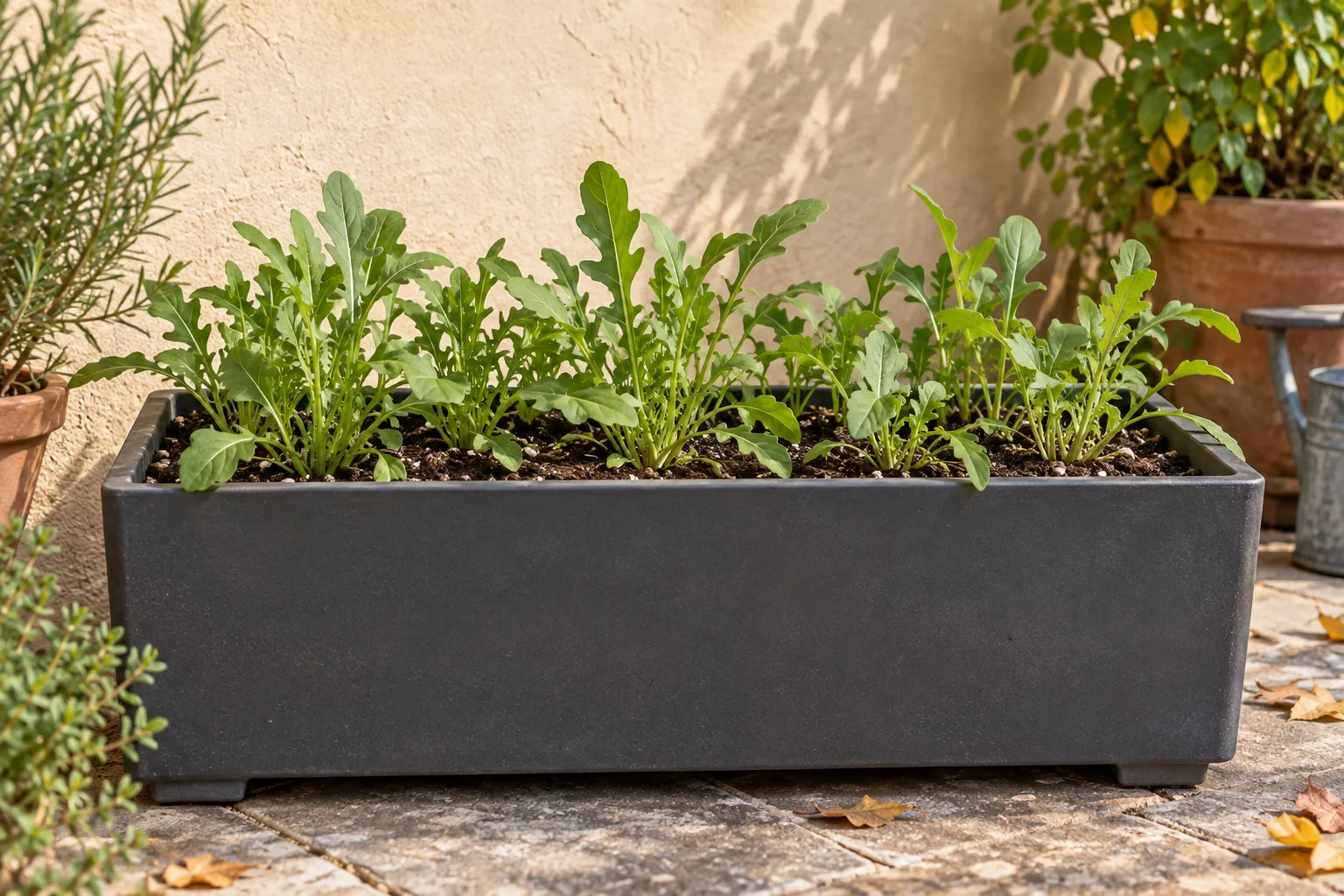
Arugula gives a small container a different job from a head of lettuce: tender, peppery leaves to pick while they are young. Start with one modest sowing and see whether you enjoy that flavor before filling several planters. Choose the harvest stage and the weather window first; the packet’s fastest maturity number is not an appointment with a salad bowl.
Find a cool growing window in your own climate
Illinois Extension describes arugula as a cool-season crop. Heat and long days encourage flowering, or bolting, and leaves can become more pungent. Its spring and fall guidance is a regional starting point. In a warm-winter area, your useful season may extend later; where hard freezes are close, an October outdoor sowing may not have enough growing time.
Check the variety’s days to the harvest stage you want, your local extension planting guidance and the forecast. As an arithmetic example, a packet listing 35 days to baby leaves plus a gardener’s chosen 14-day allowance gives a 49-day planning window. The extra fortnight is only an example, not a proven adjustment for every climate. Falling light and temperature can delay growth beyond it. Use the fall planning guide when deciding whether to sow now, protect an established crop, or wait.
Set up one accessible planter
Choose a broad container with drainage and room to reach the whole surface. For the example below, use an inside planting area 12 inches long by 8 inches wide, with about 8 inches of usable potting-mix depth and additional space above the mix for watering. This is a practical example, not a minimum-depth claim for all arugula systems. A smaller container will dry and fill with roots differently.
Maryland’s container guide emphasizes adequate drainage, suitable growing medium and enough root space. Use container mix rather than dense garden soil. Start in a location with several hours of direct light, recording the actual sunlight on your patio rather than calling a bright-looking corner “full sun.” Check nearby walls for reflected heat.
Lay out two rows for young leaves
The example adapts Maryland’s salad-box planting method, which uses rows about four inches apart, shallow seed covering and thinning for small salad plants. This guide chooses the wider end of its 1–2-inch in-row spacing. Follow your named variety’s packet if it calls for a different depth or more room, particularly for larger plants.
| Measurement in the example | Where to mark it |
|---|---|
| Two rows across the 8-inch width | Place row centers 2 and 6 inches from one inside wall: 4 inches between rows. |
| Six positions along each 12-inch row | Mark 1, 3, 5, 7, 9 and 11 inches from the end: 2 inches between positions. |
| Total after thinning | 2 rows × 6 positions = 12 young-leaf plants, if all positions establish. |
- Moisten the mix and level it without packing it hard. Mark the rows and keep the variety label with the pot.
- Sow along those rows. Maryland’s shallow-cover method uses about ¼ inch of mix; defer to the seed packet’s crop-specific directions.
- Keep the seed zone moist while germination proceeds. Use a gentle flow that does not wash seeds into one corner.
- Once seedlings establish, snip excess plants at the surface to leave your planned positions. Do not leave a crowded clump simply because every seed sprouted.
Write the sowing date and layout on the label. If emergence is patchy, compare moisture, temperature and the seed history before resowing the entire pot. The leftover-seed check can help with an old packet, but it does not guarantee outdoor establishment.
Keep growth steady and inspect the leaves
Check moisture at the pot rather than following an automatic daily schedule. Water as the mix and crop require, with drainage, and follow the fertilizer label while accounting for any feed already in the mix. Our container feeding guide explains how to avoid overlapping products. Record slow growth before deciding more fertilizer is the answer.
Illinois identifies flea beetles as a common arugula pest that can leave small holes in leaves. Look for the insect as well as the damage; holes alone do not prove its identity. A suitable row cover can exclude beetles, provided the edges are secured and pests were not enclosed with the crop. Inspect beneath it and account for heat buildup. Any pest product must be labeled for the edible crop and use.
Harvest a little, then decide on the next sowing
For a baby-leaf approach, Maryland’s salad-green harvest guide uses plants about 4–6 inches tall and describes cutting around an inch above the mix. Use clean scissors and avoid cutting into the crown if you want regrowth; inspect the remaining plants before expecting another picking. Illinois describes cutting and harvesting regrowth, but conditions determine how much another picking provides. Wash harvested leaves before preparing them.
Record when the first useful picking occurred and whether its flavor suited the meal. If the plant starts sending up a flower stalk or the leaves become too strong for your taste, a new sowing in a suitable season may be more useful than keeping the old pot indefinitely. Start another small pot only if the remaining weather window supports it; do not sow on a fixed two-week schedule into worsening conditions.
Your next steps
0 of 5 steps checked · Saved on this device
Sources & further reading
Extension resources support the growing principles in this guide. Planning examples apply them to small container gardens. Local conditions and variety instructions take priority.
- Illinois Extension: Arugula season, harvest and pests
- Maryland Extension: Salad-box sowing and thinning
- Maryland Extension: Container setup and plant care
- Maryland Extension: Harvesting young salad greens
Prepared with AI assistance; this is research-based guidance, not a personal growing trial. Editorial policy · Suggest a correction