
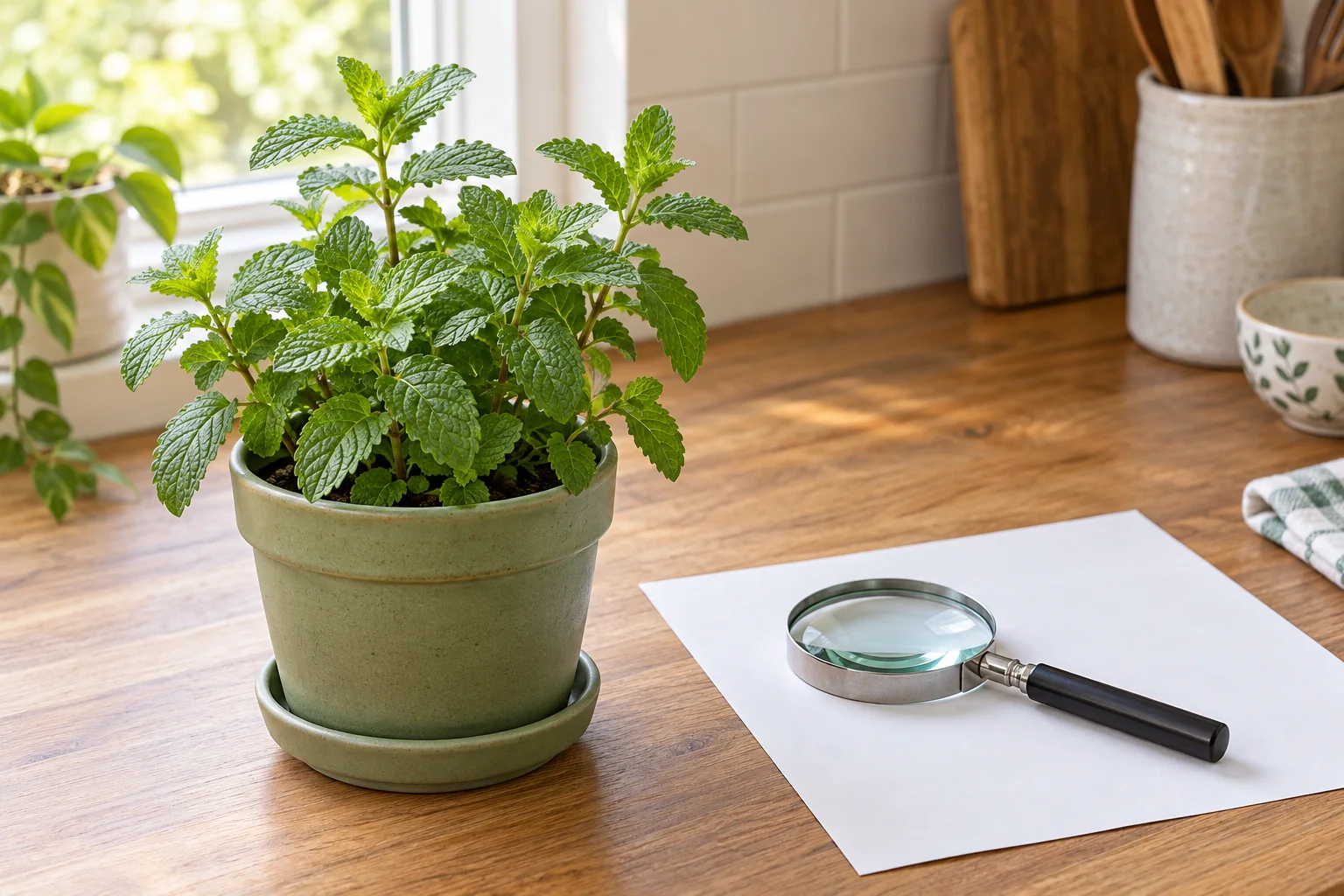
A mint or basil plant that develops pale speckles indoors does not automatically need fertilizer. Spider mites are one possibility, especially in a warm, dry room. Before treating an herb you plan to eat, look for the pest as well as its damage. This guide starts with inspection; the illustration shows the tools, not a confirmed infestation.
Look beneath a few affected leaves
Minnesota Extension describes pale stippling, later bronzing and fine webbing as useful clues. These signs can overlap with other problems. Mites are tiny, and a web on its own is not enough to decide which creature made it. A hand lens makes a better next step than a stronger spray.
- Move the pot away from other plants so its leaves do not touch neighboring foliage. Keep it in conditions suitable for that herb.
- Choose several speckled leaves and a few newer ones. Look at the undersides, veins and places where leaves join stems.
- Hold plain white paper beneath a leaf and tap gently. Use a lens to check whether fallen specks move. Dust, dry mix and bits of leaf can fall too.
- Photograph the whole plant and both sides of affected leaves. Write down where you found moving specks or fine webbing. If identification remains uncertain, send those observations to your local Extension service.
Minnesota’s indoor-pest guide includes reference photographs and recommends magnification. Use those real diagnostic examples alongside your observations. Tiny flying insects around the mix call for a different investigation, such as the fungus-gnat guide; sticky traps aimed at flying pests do not establish a spider-mite diagnosis.
| What you observe | Useful next step |
|---|---|
| Pale stippling, tiny moving specks and fine leaf webbing | Treat spider mites as a strong possibility; examine neighboring herbs and compare the reference images. |
| Yellow leaves without visible pests | Review moisture, light and roots before adding treatment. Repeat the underside inspection. |
| Larger insects clustered on soft growth | Check the aphid guide rather than assuming every sap-feeding pest is a mite. |
| Extensive webbing, leaf loss and a badly weakened plant | Consider removing the plant instead of exposing the rest of the collection during a prolonged rescue. |
Start with a response you can assess
For a manageable infestation, Maryland Extension recommends physical removal with plain water or wiping. In a sink, support delicate stems and direct a water stream at leaf undersides strong enough to dislodge pests without shredding the herb. Allow the pot to drain. Wipe accessible leaves gently, using fresh material as you move through the plant.
Remove a small number of badly damaged leaves when practical. Severely stippled tissue will not turn healthy again, so judge progress by live pests and new damage, not by whether an old leaf becomes green. For a badly infested, inexpensive herb, discarding it can be more practical than repeated treatment; clean the area and inspect nearby pots.
Keep washing tools and hands separate from care of unaffected plants, then clean them. Avoid letting the herb wilt between checks, but do not keep the roots saturated in an attempt to discourage mites. The watering guide and yellow-leaf checklist help separate those problems.
If a spray is needed, the herb and setting matter
Clemson explains that insecticidal soap works by contact and may injure sensitive or stressed plants. Homemade dish-detergent recipes are not equivalent to a product formulated and labeled for plants. Soap is not a lasting protective coating after it dries.
Before using any product, check that its label covers the pest, the particular edible herb or applicable crop group, and the intended indoor use. Follow its dilution, coverage, repeat-application and harvest instructions. A product labeled only for ornamental houseplants is not automatically appropriate for kitchen herbs. Do not substitute a generic household insect spray or increase concentration because the first treatment seemed slow.
Test a small area as the label directs before treating the whole herb. If the permitted use is unclear, ask Extension about the exact product label and herb; guessing is not a useful shortcut. This guide deliberately gives no universal pesticide mixing recipe.
Keep a short record between inspections
Make the next check comparable to the first. Label the pot and record the date, leaves inspected, whether moving specks were present, action taken, and condition of new growth. Minnesota suggests checking garden plants every 3–5 days in conditions favorable to mites; use regular close checks indoors too, while following any product’s own retreatment interval.
For example, “older leaves still spotted; no moving specks seen on four inspected undersides” is more useful than “looks better.” It is an observation, not proof that every mite is gone. Inspect neighboring herbs and new plants as part of the indoor transition routine. Persistent damage without a clear identification is a reason to seek help, not to stack several sprays.
Your next steps
0 of 5 steps checked · Saved on this device
Sources & further reading
Extension resources support the growing principles in this guide. Planning examples apply them to small container gardens. Local conditions and variety instructions take priority.
- Minnesota Extension: managing insects on indoor plants
- Minnesota Extension: twospotted spider mites
- Maryland Extension: mites in home gardens
- Clemson Extension: insecticidal soaps
Prepared with AI assistance; this is research-based guidance, not a personal growing trial. Editorial policy · Suggest a correction