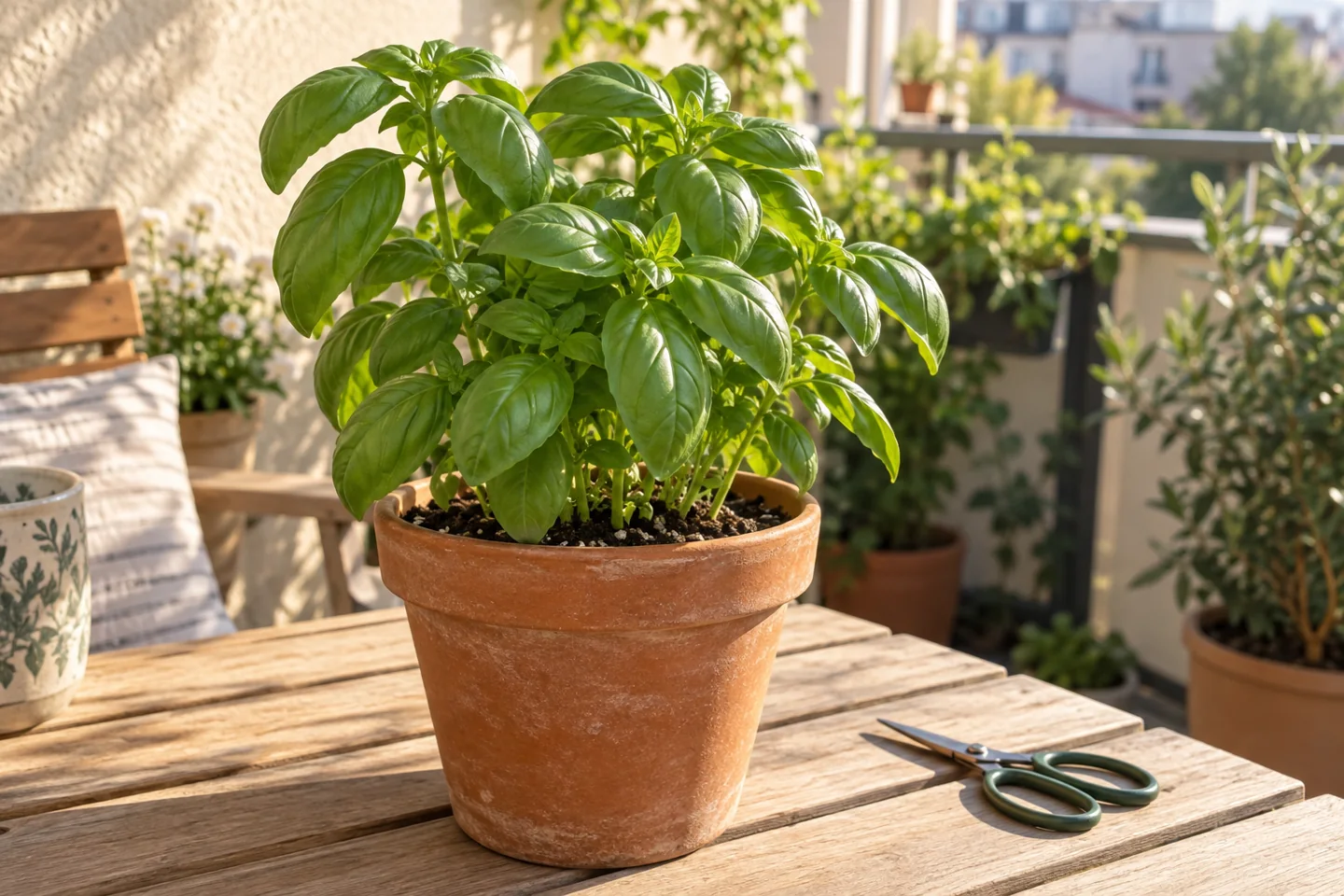
A useful basil pot starts with room for the plant you bought and a clear place to make the first cut. Give it warm conditions, check moisture below the surface, and harvest above a pair of leaves. In fall, watch the overnight forecast before you wait for a frost warning.
Choose one plant and measure its pot
For a first sweet-basil project, try one healthy nursery plant in a container about 12 inches across, with roughly 10–12 inches of usable mix depth and open drainage holes. This is a practical starting setup, not a tested minimum for every basil variety. A compact globe type and a tall Thai basil will occupy different amounts of space; keep the variety label and compare its mature size with the space you have.
Minnesota Extension describes basil varieties with very different growth habits. Look for healthy branching and inspect the leaf undersides before buying. If a supermarket pot contains a crowded cluster, count the stems emerging separately from the mix; that arrangement is a different project from the single nursery plant used here.
| Measure | Example decision |
|---|---|
| Inside width | Use the inner planting space, not the decorative lip, when judging crowding. |
| Actual root depth | A 12-inch inside height minus a 1-inch watering space gives 11 inches of mix, provided there is no reservoir or false floor. |
| Mobility | Test whether you can move the watered pot before relying on carrying it inside on a cold night. |
Fill with container mix and leave the drainage route open. UNH’s container-herb guidance explains why ordinary garden soil and an oversized wet pot can cause problems. Use our pot measurement guide if the container is sold only by outside dimensions.
Use the forecast before cold damages the leaves
Illinois Extension reports that basil can show leaf damage at 50°F. That is well above freezing: waiting for a 32°F frost forecast can be too late. Treat a forecast approaching 50°F as a prompt to choose shelter or harvest, not as a precise switch that guarantees damage at one temperature and safety at another. Duration and the plant’s actual location matter.
| Situation | Useful next step |
|---|---|
| Warm days with chilly nights approaching | Choose a bright sheltered location in advance; check that it really stays warm enough overnight. |
| A new plant going outdoors in spring | Use the local frost outlook and gradually acclimate it; a warm afternoon alone is not a planting window. |
| A mature pot near the end of its season | Decide whether to extend it indoors or make a final useful harvest. Keep expectations modest in weaker light. |
For outdoor growth, Minnesota recommends a sunny position with about 6–8 hours of bright light. An indoor move needs its own lighting plan; a bright-looking room may not deliver enough light to the leaves. Our indoor herb guide covers inspection and light checks. Basil is an annual, so moving it inside does not make one plant permanent.
Make a cut that leaves growing points behind
Illinois’s harvesting guidance calls for cutting a stem just above a pair of leaves and retaining at least half the plant. Use that as a ceiling on a healthy established plant, not a target that every harvest must reach. A recently repotted or struggling basil should give up much less.
- Choose a healthy stem tip that will provide the amount you need.
- Follow the stem down to a pair of healthy leaves that can stay on the plant.
- With clean scissors, cut the stem just above that pair. Leave the leaves and their junction with the stem intact.
- Step back and check the whole plant. Stop well before it is stripped, even if the recipe needs more.
- Look for new growth before taking another substantial harvest.
This is easier to repeat than pulling leaves from every level until only bare stems remain. If the goal is leafy growth, remove developing flower tips as you inspect. A pot kept for flowers serves a different purpose; choose deliberately rather than treating every flower as a failure.
Check water before adding fertilizer
Feel the growing medium and compare the weight of the pot with its weight after watering and draining. Water when the root zone needs it, then let runoff escape. Empty collected water from a decorative outer pot. A garden-bed watering interval is not a reliable schedule for a small exposed container.
Write down the variety, pot dimensions, overnight low, and date of each substantial cut. If regrowth slows, those notes help you separate repeated harvesting from a change in conditions. Review watering checks and the fertilizer-label checklist before adding a product simply because the plant looks pale.
Updated September 29, 2026: Added a measured planting setup, a sourced cold-damage threshold, and step-by-step harvesting.
Your next steps
0 of 5 steps checked · Saved on this device
Sources & further reading
Extension resources support the growing principles in this guide. Planning examples apply them to small container gardens. Local conditions and variety instructions take priority.
- Minnesota Extension: Growing basil in home gardens
- Illinois Extension: How to grow popular herbs
- Illinois Extension: Growing basil in your backyard
- UNH Extension: Growing herbs in containers
Prepared with AI assistance; this is research-based guidance, not a personal growing trial. Editorial policy · Suggest a correction