
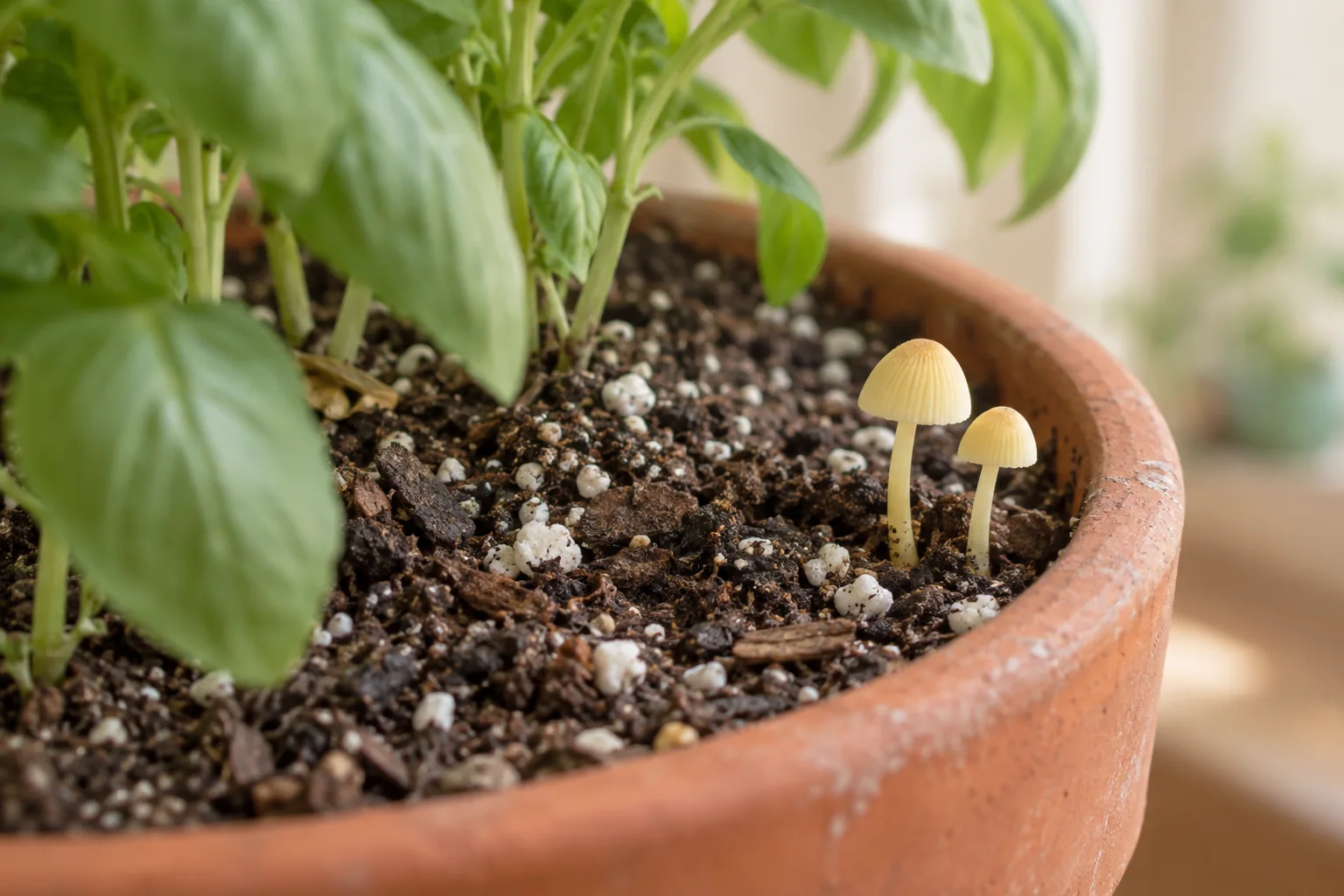
An unexpected mushroom beside an indoor herb can look alarming. It is a reason to look closely at the pot, but it does not by itself prove that the plant is diseased or that the mix must be thrown away. Keep unidentified mushrooms out of food and away from children and pets, then separate the fungal growth from the condition of the plant.
A mushroom is only the visible part
Iowa State Extension explains that a mushroom is a fungus’s reproductive structure. A less visible network can remain in the mix after the mushroom is removed. Its guidance describes a common yellow pot mushroom, Leucocoprinus birnbaumii, that decomposes dead organic material without harming living plants. That is an example of why mushrooms and plant disease are not interchangeable—not an identification of every mushroom in a pot.
The same Iowa State resource regards that common yellow species as poisonous to people and animals and recommends removing mushrooms where children or pets could reach them. Do not eat a mushroom because it appeared beside an edible crop, matches the color in a picture, or disappears quickly. The generated illustration on this page is not an identification reference. Use the extension page’s documented photographs for context, and seek qualified identification when needed.
Describe what you see before treating it
| Observation | Useful next step |
|---|---|
| A few distinct caps and stems; plant otherwise looks normal | Record the appearance and address access by children or pets. Review care without assuming root disease. |
| A green film or a white-to-gray surface layer | Check the surface-growth guidance below; do not assume it is the same organism as a mushroom. |
| A hard pale crust on the pot or mix | Use the separate mineral-buildup guide and inspect the texture rather than identifying it by color alone. |
| Wilting, leaf loss or decline as well as surface growth | Investigate the plant’s symptoms separately and prepare a complete record for extension advice. |
For a hard crust, start with the mineral-buildup guide. For tiny flying insects, consult the fungus-gnat guide. One pot can have more than one issue. Treating everything white, yellow or flying as “fungus” makes it harder to choose an appropriate response.
Check the container and moisture routine
Illinois Extension warns that an oversized pot can stay wet too long and recommends drainage holes for ordinary houseplant containers. Check whether water can leave the growing pot, including when it sits inside a decorative cover. Iowa State’s houseplant guidance advises emptying collected water rather than leaving the plant standing in a full saucer or outer pot.
- Write down the plant, pot size and when you last watered; note any recent move indoors.
- Check the mix and drainage rather than adding water automatically. Match the next watering to the crop’s needs.
- Inspect the leaves and stems as well as the surface. Photograph the whole plant and a close view of the growth.
- If you remove mushrooms to prevent access, dispose of them where children and pets cannot retrieve them, then watch for recurrence.
- Reassess at the next care check. Record whether the plant changed, not just whether another mushroom appeared.
Do not deliberately dry an herb to the point of damage to eliminate mushrooms. Use the watering guide to make a crop-appropriate decision. Likewise, repeated repotting is not a guaranteed eradication method. If there are independent signs that the plant needs a different container or mix, work through the repotting guide on those merits.
Handle surface mats as a separate problem
Maryland Extension describes algae and fungal layers on moist potting-media surfaces. Light growth is not usually harmful, but a thick mat can interfere with water entering the mix. Its management guidance includes air circulation, allowing the surface to dry between waterings where appropriate, and breaking up or removing a mat. Work gently near roots; this is surface maintenance, not proof that the whole root system is infected.
Iowa State notes that fungicide treatments are generally ineffective against pot mushrooms. Avoid pouring a household remedy into an edible plant’s pot because a mushroom returned. If the herb itself is declining, use the plant-symptom checklist and send an extension office your photos, watering history and mix information before choosing a treatment. The useful outcome is a sound care decision—not a promise of permanently fungus-free potting mix.
Your next steps
0 of 5 steps checked · Saved on this device
Sources & further reading
Extension resources support the growing principles in this guide. Planning examples apply them to small container gardens. Local conditions and variety instructions take priority.
- Iowa State Extension: yellow mushrooms in plant pots
- Maryland Extension: algae and fungal surface growth
- Illinois Extension: pot size and drainage
- Iowa State Extension: houseplant containers and care
Prepared with AI assistance; this is research-based guidance, not a personal growing trial. Editorial policy · Suggest a correction