
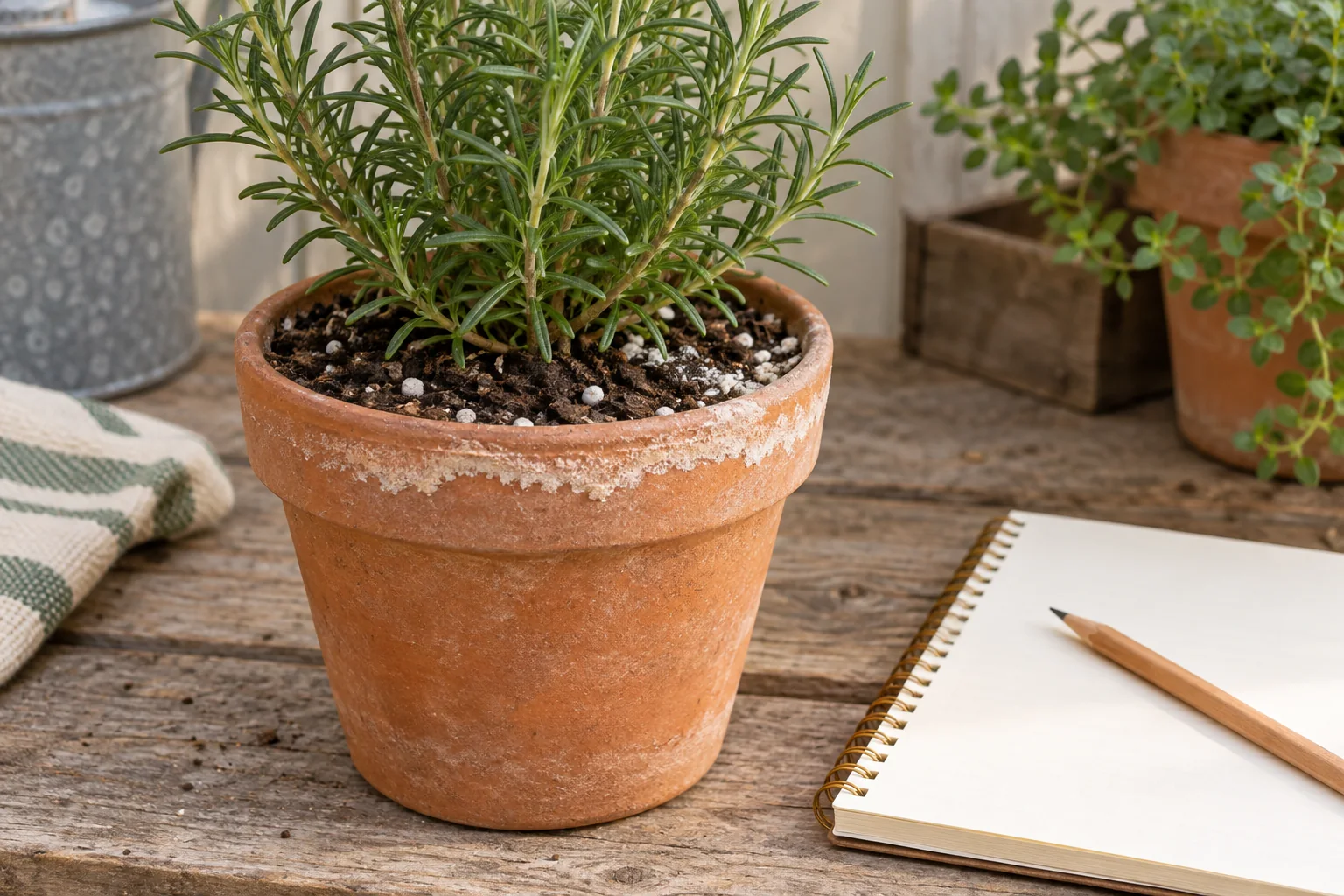
A pale crust around a pot is a reason to review water and fertilizer, not to add another feed. Mineral deposits can build up quietly while an herb still looks healthy. Start with the pot’s history and drainage, then decide whether it needs a careful rinse, fresh mix or help identifying the problem.
Describe the residue before deciding what it means
Maryland Extension describes mineral and fertilizer deposits as white crusts on pots or growing media. Hard water and soluble fertilizers can both contribute. Excess salts can interfere with water uptake and injure plant tissue. A white surface alone cannot establish the source or severity, and the illustration on this page is not a diagnostic photograph.
Take one close photograph of the residue and one of the whole plant. Note whether it is a continuous crust, separate pieces already present in the bagged mix, or a fuzzy growth. White perlite particles are an ingredient in many mixes; compare with the original product before trying to remove every pale speck. If the material is fuzzy, spreading or accompanied by plant decline, describe it to an extension service rather than assigning it a chemical cause from color.
| Observation to record | Why it changes the next step |
|---|---|
| Where it appears | Record the pot wall, rim, mix surface and any leaf residue separately. One photograph may miss the pattern. |
| Water and feeding history | Write the actual water source, fertilizer product, dose and dates, including feed already present in the mix. |
| Drainage and root-zone moisture | A pot that remains saturated needs drainage assessment before more water is poured through it. |
| Plant condition | Record new growth, wilting and damaged leaf margins. These signs have multiple possible causes. |
Check what has been added to the pot
Gather the mix bag and all fertilizer labels. Two products used exactly as their separate labels describe can still overlap in the same pot. Penn State identifies excessive feeding and combinations of slow-release and soluble fertilizer as possible causes of high salt concentrations. Pause an unplanned extra application while you reconstruct the record; use our feeding log to avoid losing the original dose information.
A useful entry reads “one labeled dose mixed into two quarts of water; only part of that solution applied to this pot,” not simply “fertilized.” Record what you know and mark missing amounts as unknown. Do not invent the dose later to make the log complete. If you discover a major application error, retain the package and contact the manufacturer or extension service with the amount and pot size.
Penn State explains that electrical conductivity measures dissolved salts in irrigation water. Water that looks clear is not necessarily low in dissolved minerals. For recurring deposits, ask about testing the actual water you use. A water report and a potting-mix test answer different questions; neither can be replaced by looking at the rim.
Only rinse a pot that can drain freely
For freely draining indoor pots, Maryland recommends flushing accumulated salts from the top with low-mineral water; its general houseplant guidance uses at least three pot volumes, with complete drainage. For a two-quart pot, that reference amount is 2 × 3 = 6 quarts, applied gradually through the mix—not held around the roots. This is a scale example, not an instruction to pour six quarts into a saturated pot.
- Confirm that water can leave the growing pot. Remove it from a non-draining decorative cover if practical; protect the surface below.
- Arrange a place to collect and dispose of runoff appropriately. Keep it from flowing onto a neighbor’s balcony or back into another plant.
- Allow the water to pass through and the pot to finish draining. Do not leave the base soaking in the discharged water.
- Record the action and reassess plant condition before adding fertilizer again. Old damaged leaf edges will not provide an instant recovery signal.
Use this approach only for a manageable, freely draining pot. Reservoir planters and hydroponic systems need their own maintenance instructions. Penn State cautions that an excess of slow-release fertilizer is not readily corrected by leaching. Repeatedly flooding an uncertain problem is not a substitute for identifying it. See the drainage guide if the water has nowhere to go.
Use testing or fresh mix when the problem persists
Maryland notes that severe buildup may call for repotting in fresh growing media. Before disturbing a struggling herb, ask whether the issue is salts, poor drainage or something else. Penn State describes a soilless-media test for pH, soluble salts and nutrients. Tell the laboratory you are sampling container mix, follow its sampling instructions, and have the result interpreted for your crop. Do not apply a field-soil threshold to a different extraction method.
Keep the follow-up modest: photograph the same view, note the next watering and watch new growth. If the crust returns, revisit the water and fertilizer inputs instead of merely hiding it under more mix. Our plant-symptom guide can help organize other observations. The goal is to change the cause you can document, not to make a pot look clean for a day.
Your next steps
0 of 5 steps checked · Saved on this device
Sources & further reading
Extension resources support the growing principles in this guide. Planning examples apply them to small container gardens. Local conditions and variety instructions take priority.
- Maryland Extension: Mineral and fertilizer deposits
- Penn State: Over-fertilization and slow-release limitations
- Penn State: Interpreting irrigation-water tests
- Penn State: Testing soilless growing media
Prepared with AI assistance; this is research-based guidance, not a personal growing trial. Editorial policy · Suggest a correction