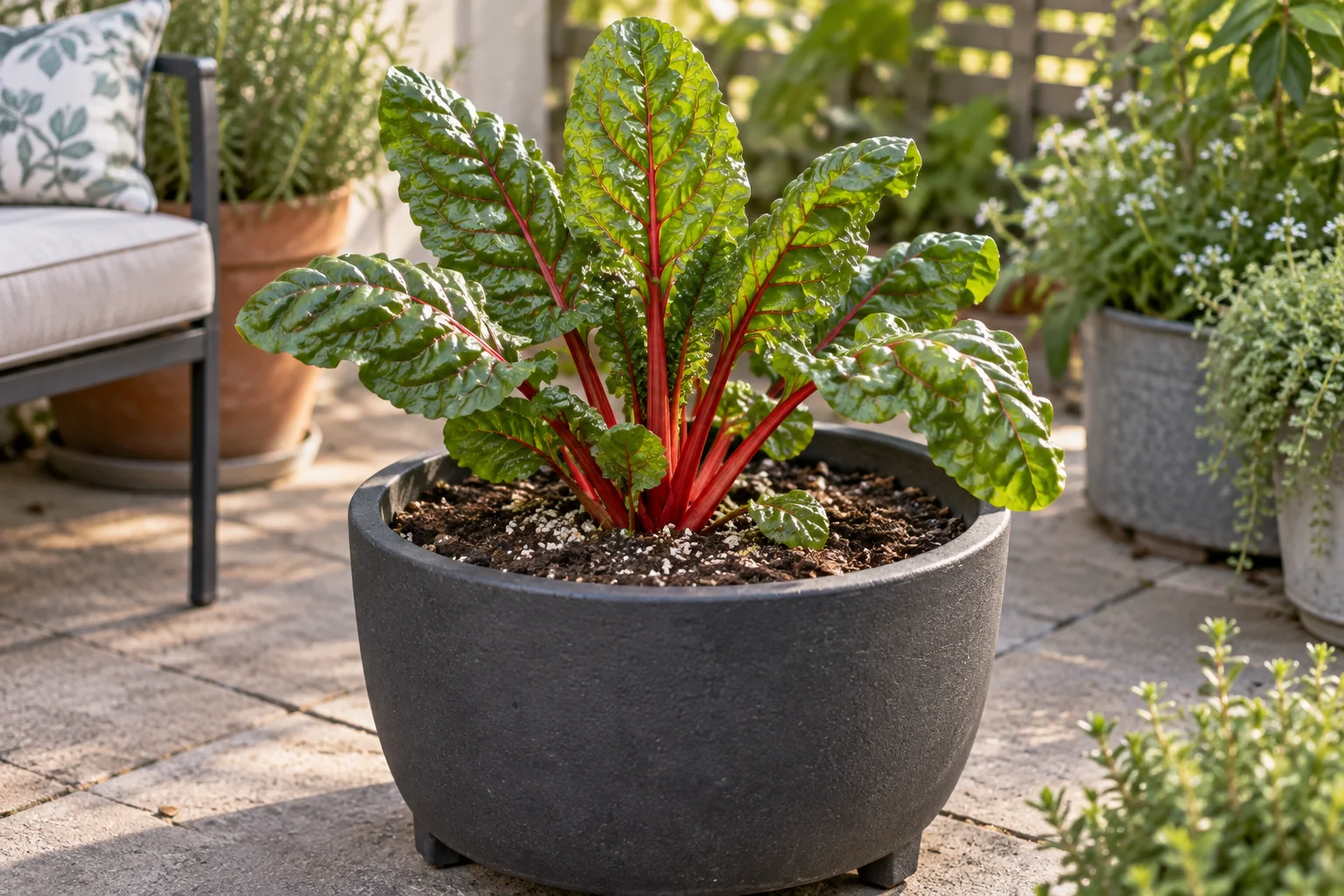
Swiss chard earns its pot space with leaves and substantial stalks rather than a swollen beet root. Start with one plant you can reach from all sides. The main decision is whether you want small leaves or a larger plant for repeated outer-leaf pickings; that choice determines how soon a crowded sowing must be thinned.
Choose the harvest before choosing the pot
Minnesota Extension distinguishes chard’s leaf crop from beetroot and notes that wider spacing gives larger plants, while close spacing produces smaller leaves. If you want broad cooking leaves and developed stalks, leave room for an individual crown rather than treating a whole packet as one planting unit.
Illinois’s container chart lists one chard plant in a one-gallon container. That is a starting reference, not a reason to choose the smallest possible pot for a long season. For a manageable first project, one pot roughly 12 inches across with about 12 inches of usable depth gives you a roomier example to plan around. These dimensions are an example, not a researched minimum for every variety. Use the container-size guide and check the actual internal dimensions.
Choose drainage holes and container growing mix, leaving space below the rim for watering. Illinois’s planting guidance calls for suitable mix, drainage and attention to moisture. Keep a record of fertilizer already included in the mix before adding more. A decorative outer pot must not leave the growing pot standing in runoff.
Check light and season before sowing
Maryland Extension lists 6–8 hours of direct sun as best for chard, with tolerance of 4–6 hours. Check the light at leaf height, including shade from a balcony wall. A bright view of the sky is not a count of direct sunlight; use the sunlight observation method if the location is uncertain.
Maryland gives about 50–70 days from direct sowing to maturity and describes tolerance of light frost, not an exposed pot surviving every winter. Variety, harvest stage and weather change the timetable. In a cold-winter region, October may be time to harvest established chard and plan next spring, rather than start seed outdoors. Mild-winter gardeners should use their local extension planting window. A seedling does not erase a rapidly closing season.
Sow, then thin the seedlings you actually get
Chard seed is commonly a seed ball containing several embryos; seed labeled monogerm is an exception. More than one seedling may therefore appear where you placed one seed ball. Count stems after emergence instead of assuming that careful sowing eliminated the need to thin.
- Moisten the potting mix and label the crop, variety and date. Sow at the packet’s depth; Minnesota gives a general depth of ¼–½ inch for chard.
- Keep the seed zone moist without leaving the pot saturated. Record emergence and inspect any clusters.
- For the single mature plant planned here, retain one well-placed seedling and snip unwanted stems near the surface. Avoid tugging through the roots of the one you keep.
- If starting with a transplant, use a healthy plant, handle its roots gently and settle it at its existing growing depth. Acclimate indoor-grown plants before their outdoor move.
| Harvest plan | Space decision |
|---|---|
| One larger plant in its own pot | Retain one crown. Leave its center accessible for inspection and harvesting. |
| Several larger plants in a trough | Maryland gives 8–12 inches between larger plants. Account for the ends of the trough as well as the gaps. |
| Young leaves at closer spacing | Plan early thinning or harvest. Closely spaced seedlings do not become full-sized plants without more room. |
For example, a 24-inch-long trough can place two plant centers at 6 and 18 inches: 12 inches apart with 6 inches to each end. This checks one dimension only; it does not establish sufficient trough width, depth or growing volume. Use our outdoor transition guide for plants started inside.
Harvest outer leaves and keep the growing center
Illinois advises cutting young, tender outer leaves about 1½ inches above the ground while protecting the central bud. In a pot, use the mix surface as that reference. Choose usable outer leaves, support the stem as you cut, and leave the emerging center intact. Avoid stripping a small plant faster than it can replace its leaves.
Check moisture at the pot and follow a suitable fertilizer label rather than increasing feed to compensate for poor light. Inspect leaf undersides and new growth; identify an insect or disease before choosing treatment. For unexplained damage, Maryland links specific chard problem references. A hole or blotch by itself is not a diagnosis.
Record the picking date, which leaves you removed and whether new growth is replacing them. Chard is perishable, so harvest near the meal, refrigerate promptly if storing, and wash before preparation. When frost threatens, use the forecast-based frost plan and make a harvest decision before leaves are damaged. Repeated pickings depend on the plant’s condition; a pot does not promise a weekly quantity.
Your next steps
0 of 5 steps checked · Saved on this device
Sources & further reading
Extension resources support the growing principles in this guide. Planning examples apply them to small container gardens. Local conditions and variety instructions take priority.
- Minnesota Extension: Chard growth and planting
- Maryland Extension: Chard spacing, season and seed balls
- Illinois Extension: Chard harvesting
- Illinois Extension: Vegetable container planting
Prepared with AI assistance; this is research-based guidance, not a personal growing trial. Editorial policy · Suggest a correction