
Start here
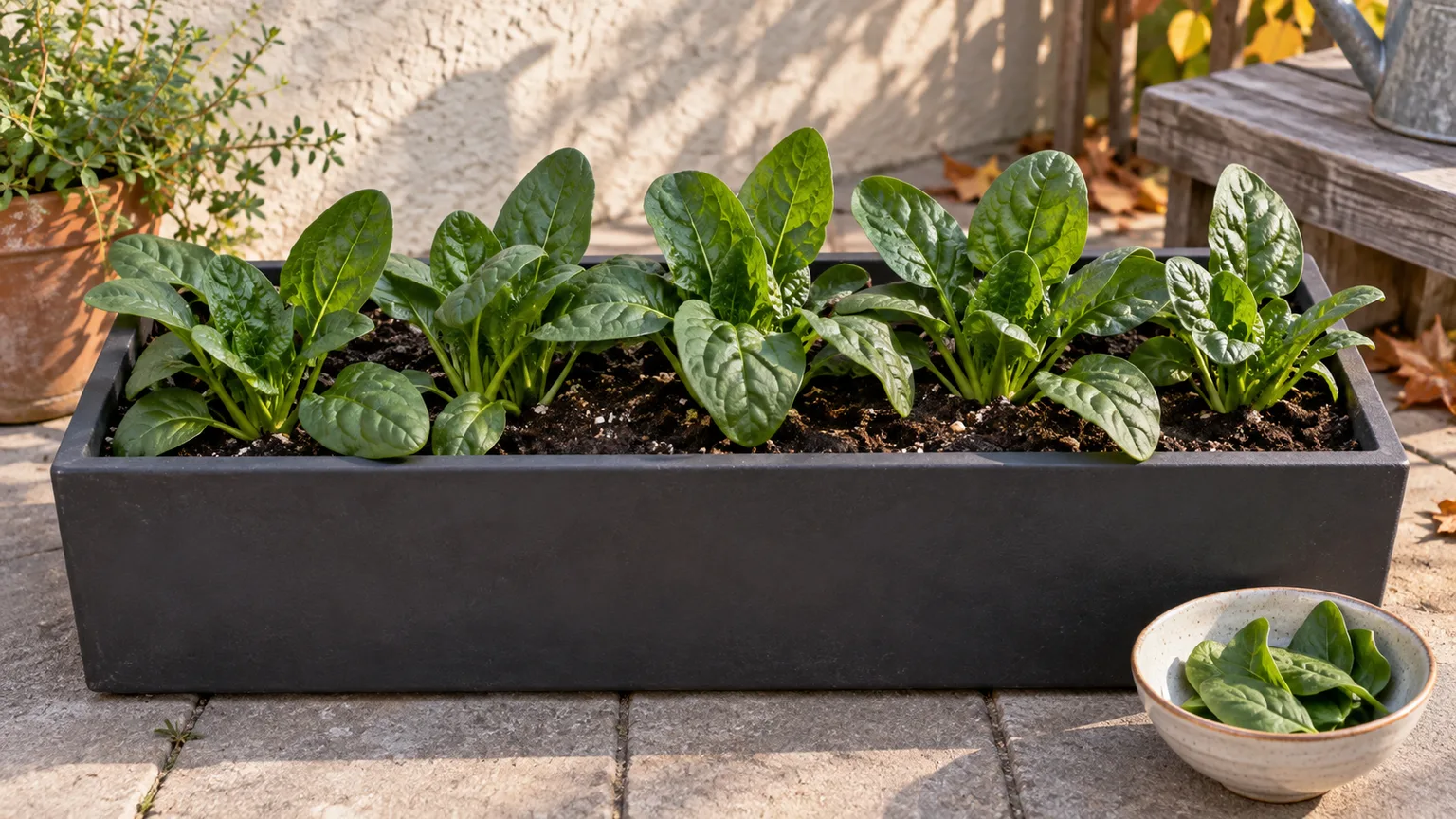
Grow spinach in a broad, draining container during a cool part of your local growing season. Start with a small sowing, give the seedlings room, and pick a few outside leaves at a time. A pot can provide useful handfuls; it is not a promise of a grocery-store-sized harvest.
An empty planter after summer is an invitation to grow something different. Spinach is a good project when you want leaves for an omelet or a sandwich and can check a container regularly. The first decision is timing: a September date means very different growing conditions in Minnesota, coastal California, and south Texas.
Choose a cool growing window
Spinach seed germinates best around 55–65°F, and temperatures above 80°F reduce germination. Warm conditions and long days also encourage flowering rather than a long leaf harvest. Those are useful reasons to check the temperature of the mix instead of planting simply because the calendar says fall. Utah State’s spinach guide explains the temperature response.
For a fall sowing, look up your local extension planting calendar and compare it with the variety’s packet. An early-maturing variety gives you another useful choice, but a days-to-maturity number is an estimate, not a harvest appointment. If the local sowing window for a harvest this season has passed, choose the next locally recommended window. In a cold region that may be spring; in a mild-winter region, winter itself may offer a growing window. Sowing extra seed does not recover lost growing time.
Choose a spot with good autumn light. Maryland Extension describes spinach as able to grow with four to six hours of direct sun, while also doing well in full sun during spring and fall. A balcony that was sunny in June may be shaded now: use our sunlight check before choosing the planter’s position. Maryland’s spinach recommendations are useful background; their seasonal timing is regional.
Choose the harvest you are planning for
Before opening the packet, decide whether you want leaves from a new sowing this season, to keep an established crop through cold weather, or to start at the next suitable planting window. These are different projects.
| Your situation | A useful next decision |
|---|---|
| Your local sowing window is open and the mix is cool enough | Try one small sowing. Record the variety, sowing date and the harvest stage described on the packet, such as baby leaves or full-size leaves. |
| The fall sowing window has closed and prolonged freezes are approaching | Do not count on a fresh sowing for an imminent meal. Plan the next local window, or investigate a locally supported overwintering method as a separate project. |
| You garden through a mild winter | Check the winter calendar for your region instead of importing a northern spring schedule. For example, UF/IFAS lists October–February for spinach sowing in South Florida; those dates are not a national recommendation. |
| You already have an established crop as winter approaches | Separate leaves you can pick now from hoped-for future growth. Maryland describes overwintering in mild areas for renewed spring growth; that does not promise continuous winter picking or survival in an exposed container. |
The regional examples come from UF/IFAS Florida Fresh and Maryland Extension. Use our container frost plan when deciding where a pot can stay. An in-ground overwintering recommendation is not a guarantee for roots in an exposed pot.
Make a calendar check, not a harvest promise. Write down the packet’s stated harvest stage and whether its day count starts at sowing or transplanting. For a hypothetical packet saying 45 days from sowing, October 1 plus 45 days is November 15. That arithmetic only identifies a date to compare with local conditions; it does not establish that the plant will reach that stage then. Do not use a baby-leaf date as a full-size harvest date, and do not extend a closed local sowing window just because the sum fits on the calendar.
Set up one manageable planter
For a first project, a broad container roughly 10–12 inches deep is a practical choice, rather than a tiny decorative bowl. This is a manageable starter size, not a universal minimum for every spinach variety. Confirm its internal dimensions before buying mix, and keep enough room around it to reach every plant.
Use a container potting mix and open drainage holes. Water should be able to leave the pot rather than sit in a sealed outer cover. Check moisture below the surface and water thoroughly when needed; a fixed daily splash is a poor substitute for checking the actual mix. See Maryland’s container-care guidance and our watering guide.
Sow a small batch and mark the date
- Moisten the mix before sowing so you can make shallow planting holes without washing seeds around.
- Follow the packet; a typical spinach sowing depth is about half an inch. Cover gently and water with a fine rose.
- Write the variety and sowing date on a label. Photograph the label with the planter so you have a simple record.
- Thin after seedlings have established true leaves, using the final spacing on the packet. Around four inches between plants is a useful container starting point; larger varieties may need more.
The sowing depth follows Utah State’s guidance; the RHS container guide uses roughly four-inch spacing for spinach. RHS planting months describe the U.K., so use its container principles with your U.S. local planting calendar.
Here is a layout exercise, not a yield forecast: on a planter with a 24-inch internal length, five planting positions four inches apart fit in one row with four inches left at each end. Mark those positions before sowing. Measure the planter’s width separately before adding another row; a narrow window box does not automatically have room for two.
Use a short care routine
Each check can answer three questions: Is the mix drying? Are the leaves changing? Is the planter still receiving useful light? Keep a brief note when something changes instead of changing water, fertilizer, and location all on the same day. That makes it easier to understand which adjustment helped.
Read the potting-mix label before adding fertilizer; some mixes already contain it. Use a product labeled for the crop and container, and follow its rate. Our container fertilizer guide explains how to avoid stacking several products. More fertilizer cannot replace an appropriate season.
Pick leaves without ending the whole crop
Harvest outside leaves while leaving the central growing point intact. Maryland Extension notes that removing full-size leaves can encourage more leaves from the crown; once a flower stalk develops, make your final harvest. Check the undersides of leaves as you pick, and investigate damage rather than assuming every hole means the same pest. Read the crop-care and harvest notes.
For a first pot, record the date of the first usable picking and what you used it for. “Enough leaves for two sandwiches” is a more useful personal result than borrowing a field yield and scaling it down to an untested container.
Two common questions
Can spinach live through a frost?
Spinach tolerates cold better than tender summer vegetables, but a frost-tolerant leaf is not a guarantee that an exposed pot will survive a long freeze. Use our container frost plan and judge the conditions at your own site.
Can I plant the entire packet at once?
You can, but a small first sowing is easier to space and observe. Save seed according to its packet and use a later sowing only while your local planting window still supports it. That also leaves room to change your approach after the first batch.
Your next steps
0 of 5 steps checked · Saved on this device
Sources and further reading
- Utah State University Extension: How to Grow Spinach
- University of Maryland Extension: Growing Spinach
- RHS: Vegetables in Containers
- University of Maryland Extension: Container Vegetable Gardening
- UF/IFAS Florida Fresh: Spinach planting seasons
Growing recommendations vary with climate and variety. The planting layouts and planning examples in this guide apply the linked research to a small container garden.
Updated October 29, 2026: Added a sowing-versus-overwintering decision table, regional winter examples and a checked calendar-planning example. Original publication date retained.