
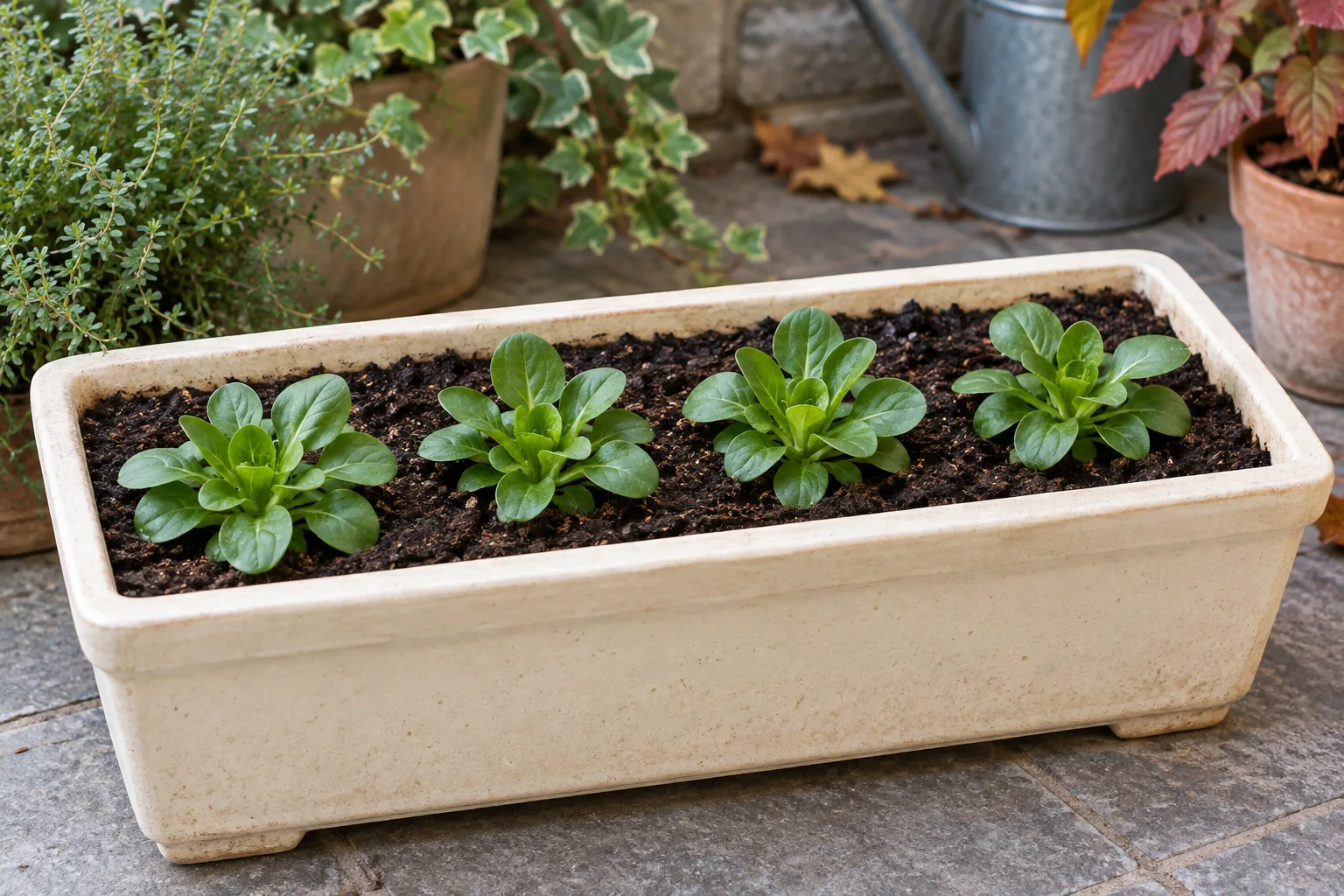
Mâche is a small salad green for cool conditions, not a miniature heading lettuce. Its main hurdle can come before you see a leaf: a sunny planter that is still warm may be unsuitable for germination even when the calendar says autumn. Check the growing conditions before opening the packet.
Know what the packet contains
Mâche, corn salad and lamb’s lettuce are names for Valerianella locusta. Wisconsin Extension describes its compact rosettes and delicate leaves. Expect small plants with smooth, spoon-shaped foliage rather than a large lettuce head. In a small-space plan, treat it as a modest salad addition; the size of a planter is not evidence of a guaranteed bowl-per-week yield.
Keep the packet so you can compare its sowing and harvest information with your actual results. A single-variety sowing is easier to identify and monitor than an unlabeled mixture. For help separating seed-packet instructions from marketing, use the seed packet guide.
Check the mix temperature before sowing
Utah State recommends soil temperatures of 41–68°F for germination and notes that seed can become dormant above 70°F. Those are soil temperatures, not the overnight air forecast. A container beside a sun-warmed wall may stay much hotter than the surrounding air. Check the mix where the seeds will sit, following your thermometer’s instructions.
| Your situation | A useful next step |
|---|---|
| Cool nights but a hot planter in afternoon sun | Measure the mix during the warmer part of the day before sowing. |
| The seed bed is still above the recommended range | Wait for cooler conditions or choose a cooler position; do not assume more water fixes heat-related failure. |
| Suitable temperatures and time for growth remain | Sow a small labeled batch and record the conditions. |
| Hard freezes are imminent in your area | Plan a protected growing space or a later sowing window rather than promising an autumn harvest. |
Utah’s outdoor planting dates are regional. In much of the South, the useful cool-season window arrives later than in northern states. In cold regions, late autumn may offer too little time for meaningful growth. Ask local extension about timing and consult the container frost guide before counting on winter production.
Prepare a broad, draining container
Maryland Extension places salad greens among crops suited to small containers, with a general starting range of 1–3 gallons and 4–6 inches of growing-medium depth. Consider depth and volume together. A broad planter with about 6 inches of usable mix is a practical choice; a decorative tray with only a thin layer of soil is not equivalent.
Check drainage before filling with prepared container mix. Keep holes open and empty collected water. The RHS recommends larger salad containers, at least 12 inches wide, because tiny pots dry faster. Moisten the mix before sowing so the first heavy watering does not move the seeds into a corner.
Sow shallowly and leave room for rosettes
Utah State suggests direct sowing about ¼ inch deep. Once seedlings have three or four true leaves, thin them to roughly 3–4 inches apart in the row. Use the packet if its cultivar needs more space. For a narrow window box, a single row keeps the spacing easy to check and leaves each plant accessible.
For example, four plant centers at 4, 8, 12 and 16 inches along a 20-inch planter give 4-inch spacing and 4-inch end margins. This is a layout example, not a tested capacity or yield claim. Draw the positions before sowing, and avoid adding extra seedlings merely because the bare mix looks empty.
Maintain and pick a small crop
Keep the seed bed evenly moist, then monitor moisture as roots develop. Utah State recommends full sun and cool growing conditions for established plants. The RHS notes that container salads need regular watering and protection from slugs. Check under rims and around hiding places if seedlings disappear. Feed according to the potting mix and fertilizer labels rather than converting a field application rate into a scoop for one pot.
Utah State describes harvesting outer leaves while the center continues growing, or taking whole small plants. Choose one approach for each plant and leave enough foliage when picking repeatedly. Record the first usable harvest and how quickly the pot regrows. Those observations will tell you whether another sowing is worth the space in your own conditions.
Your next steps
0 of 5 steps checked · Saved on this device
Sources & further reading
Extension resources support the growing principles in this guide. Planning examples apply them to small container gardens. Local conditions and variety instructions take priority.
- Utah State: Lamb’s lettuce in the garden
- Wisconsin Extension: Salad greens
- Maryland Extension: Container sizes and drainage
- RHS: Growing salad leaves
Prepared with AI assistance; this is research-based guidance, not a personal growing trial. Editorial policy · Suggest a correction