
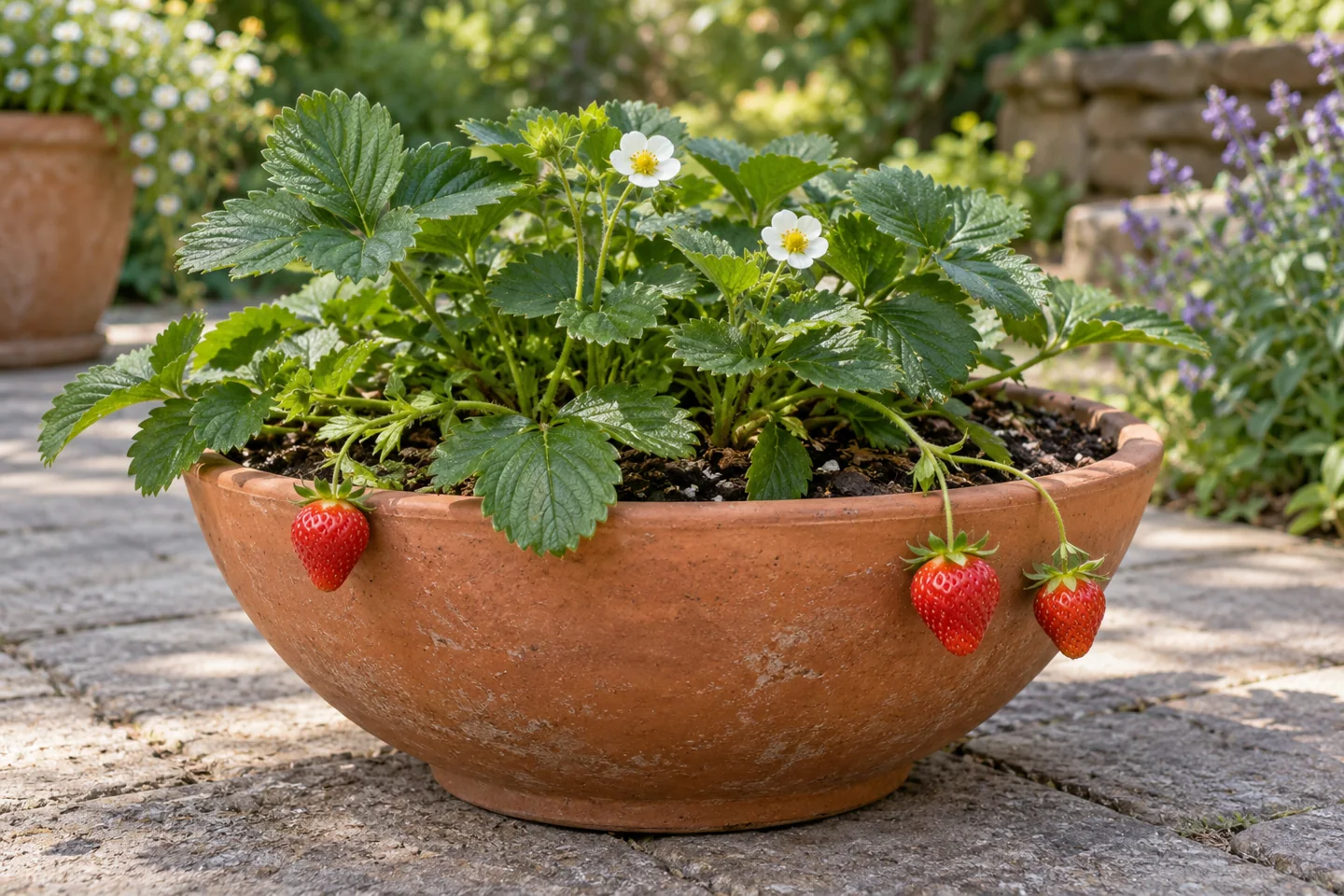
A strawberry pot works best when you can reach each plant, keep the roots evenly supplied with moisture, and see where the crown meets the mix. Choose the harvest pattern first, then mark the planting positions. Leave enough room to inspect the plants rather than filling every gap with another crown.
Choose the plant type and the planting surface
Minnesota separates June-bearing, everbearing and day-neutral strawberries. June-bearers concentrate their harvest; everbearers usually have two main crops; day-neutral types can fruit over a longer season. Those descriptions are not a promise of continuous berries in every climate. Match a named cultivar to local conditions and record its type on the pot label.
Iowa State recommends containers at least 12 inches across and eight inches deep, with plants ideally about eight inches apart. Its container guide favors day-neutral and everbearing types. Measure the usable inside surface and planting depth; decorative lips, false bottoms and watering headroom can make outside dimensions misleading.
For an easy rectangular example, suppose the usable surface is 24 inches long and 12 inches wide. Mark one row halfway across the width, then three centers at 4, 12 and 20 inches along its length. That gives two eight-inch gaps and four-inch end margins: 4 + 8 + 8 + 4 = 24. This is an original planning example using the cited spacing, not a density trial. Wider cultivar instructions take priority, and leaves still need surrounding access space.
Set the crown at the surface
The crown is the compact central stem between the leaves and roots. Minnesota places the middle of a dormant bare-root crown at the soil line, with roots buried and growth visible. For an actively growing nursery plant, retain its original planting depth. The diagram shows the bare-root placement principle; it is not a scale drawing of every cultivar.
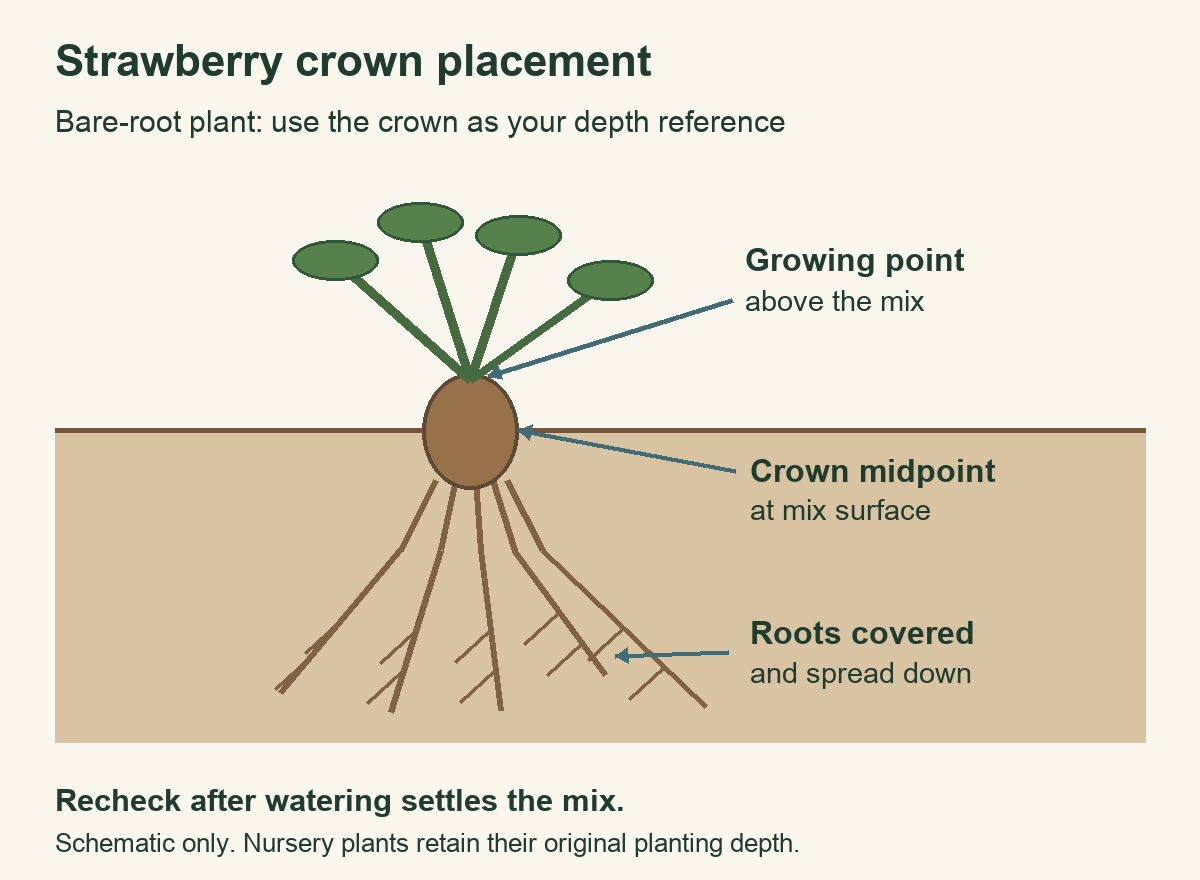
Open the full-size crown-placement diagram.
- Find the crown before digging the planting hole. Do not use the leaf tips as the depth reference.
- Make room for the roots to extend down and spread naturally, rather than folding them upward to fit a shallow hole.
- Hold the crown at the intended surface level while filling around the roots. Keep the growing point visible.
- Firm gently, water, and look again from the side after the mix settles. Correct a plant that has sunk or has exposed roots.
Take one side-on photograph after planting and keep it with the cultivar label. It gives you a useful comparison if settling or exposed roots become a problem later. For nursery transplants, compare the old root-ball surface with the new mix surface before finishing.
Keep a small care and harvest record
Maryland describes strawberries as shallow-rooted and vulnerable to very dry or wet conditions. Check the actual mix and use the watering decision guide. A hanging basket or small side pocket needs its own check; do not assume the damp bottom of a large planter proves that every plant has water.
| Record on each visit | Decision it supports |
|---|---|
| Mix condition at the plants; rain and heat | Whether watering is needed and which section needs attention. |
| New runners, leaves and fruit condition | Where crowding or a developing symptom needs a closer look. |
| Fertilizer already in the mix; product and date used | Whether another application would duplicate the existing feed. |
| Ripe berries picked and damaged berries removed | Your actual usable harvest, without assuming a promised yield. |
Maryland advises removing runners from day-neutral plantings and waiting for fully red fruit. Do not rely on pale berries becoming sweeter after picking. Keep questionable or damaged fruit separate and wash sound berries before eating. Use the feeding record to read the mix and fertilizer labels together.
Make the winter decision before buying more plants
Iowa State recommends treating container strawberries as annuals because overwintering them is unreliable. That is particularly relevant to exposed pots in cold winters; a perennial plant label is not a guarantee that its container roots survive. Maryland describes options for maintaining strawberry plantings over more than one year, but a bed’s winter protection cannot simply be copied to a balcony pot.
For this October update, decide whether you are finishing a planting, preparing a locally appropriate winter plan, or shopping for next season. Ask local extension staff about your cultivar, container size, location and available protection before choosing to keep it. In a mild-winter growing region the planting calendar may be different. If replacement is the practical choice, record the successful pot position and variety, then use the mix-reuse guide when clearing the container.
Updated October 3, 2026: Added measured spacing, a crown-placement diagram, and region-qualified end-of-season choices.
Your next steps
0 of 5 steps checked · Saved on this device
Sources & further reading
Extension resources support the growing principles in this guide. Planning examples apply them to small container gardens. Local conditions and variety instructions take priority.
- Iowa State Extension: Strawberries in containers
- Minnesota Extension: Growing strawberries
- Maryland Extension: Growing strawberries
Prepared with AI assistance; this is research-based guidance, not a personal growing trial. Editorial policy · Suggest a correction