
A small grow light has two separate jobs to justify: supplying useful light to your plants and fitting your household budget. You can estimate its electricity use with three numbers—input watts, hours on and your electricity rate. Keep that estimate separate from the purchase price and from any claim that homegrown herbs will pay for the setup.
Estimate your grow light’s energy charge
The starting numbers are an illustrative example: 40 watts, 14 hours a day, 30 days and 20 cents per kWh. Replace them with your fixture’s electrical input and your own rate. Enter 20 for a rate of $0.20/kWh.
Enter your inputs, then estimate energy and cost. The sample is not a local utility quote or a measured product result.
Inputs are processed on this page and are not saved or sent to our server. Download before leaving. The estimate excludes equipment purchases, fixed fees, taxes, demand charges and unentered devices. Use your utility’s tariff for complex or changing rates.
Write down the input watts and actual schedule
Virginia Cooperative Extension calculates energy use from wattage and operating time. Read the fixture’s electrical input specification or nameplate. Do not substitute a model number or an “equivalent” brightness claim for input watts. If the fixture is dimmable, check whether the quoted value is maximum input or the draw at your chosen setting; a 50% control position is not proof of exactly half the electrical draw.
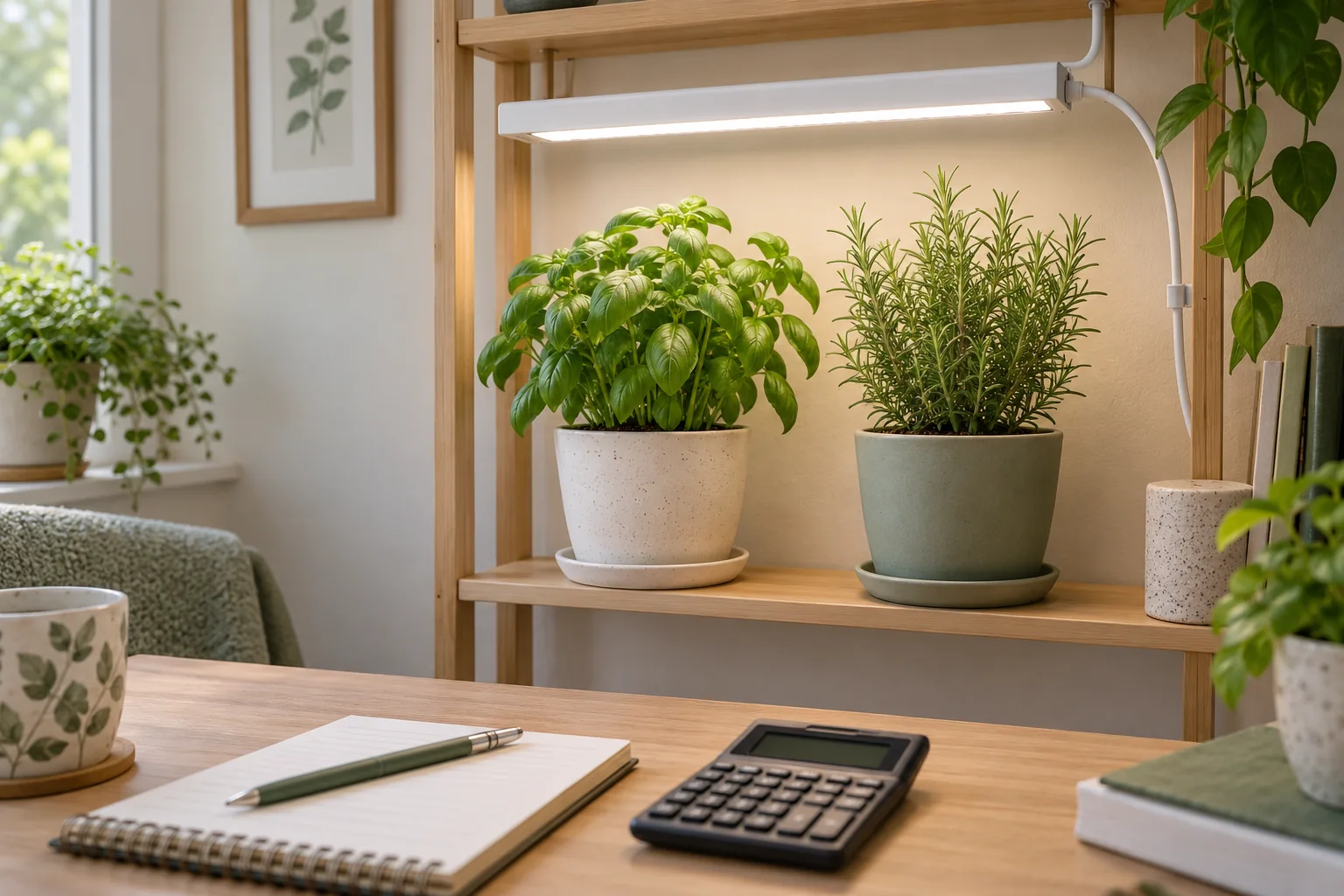
List every device you want included. Two bars drawing 20 watts each total 40 watts while both are on. A timer, fan or heat mat may add use on a different schedule. Keep those on separate lines unless their combined draw and operating time are known. The illustration is a general herb shelf, not a tested 40-watt product.
Iowa State suggests 12–16 hours of supplemental light for indoor herbs. Choose a schedule that suits the crop and fixture, then write the actual on/off times: 7 a.m. to 9 p.m. is 14 hours. Check the timer after an outage. This article estimates cost; the indoor-herb guide covers plant selection and care.
Turn watts into kilowatt-hours, then dollars
Energy in kWh = input watts ÷ 1,000 × hours per day × days used. Multiply that energy by the rate in dollars per kWh. This is the extension energy-use formula applied to a garden light. A watt measures power; a kilowatt-hour measures energy used over time.
For a hypothetical 40-watt light running 14 hours daily for 30 days: 40 ÷ 1,000 × 14 × 30 = 16.8 kWh. At an example rate of $0.20/kWh, that is 16.8 × $0.20 = $3.36 for those 30 days. The rate and wattage are examples, not a local quote or a measured product result. For the manual dollar formula in this paragraph, 20 cents/kWh is $0.20/kWh. The calculator above asks for cents, so enter 20 in its rate field; it performs that conversion for you.
| Example input | 30-day energy | At $0.20/kWh |
|---|---|---|
| 20 watts | 8.4 kWh | $1.68 |
| 40 watts | 16.8 kWh | $3.36 |
| 80 watts | 33.6 kWh | $6.72 |
Use the actual number of operating days. Running that 40-watt example for only 10 days uses 5.6 kWh and costs $1.12 at the same sample rate. A 31-day month is different from the 30-day illustration; do not label a daily number as a monthly bill.
Use your utility rate, not a national average
The U.S. Energy Information Administration explains that prices vary by location and rate structure, and some utilities price electricity by time of day. Read your current rate schedule or ask the utility which per-kWh charges apply to additional use. A flat customer fee generally belongs to the household bill rather than being newly caused by one small light; this worksheet estimates the added energy charge, not the entire bill.
For a time-of-use plan, calculate each daily price period separately. Suppose the same 40-watt lamp runs four hours at a fictional $0.30/kWh and ten hours at $0.12/kWh. Its daily energy charge is (0.04 × 4 × 0.30) + (0.04 × 10 × 0.12) = $0.096, or $2.88 over 30 days. Actual tiers, taxes, adjustments or demand charges require your own tariff; the example is not a promise of bill savings.
Compare useful coverage before calling a lamp efficient
Iowa State notes that watts do not reliably describe the light reaching plants. A lower-power fixture may cost less to operate but cover less of the shelf or deliver insufficient light. Compare the manufacturer’s plant-light output, coverage and mounting guidance for the intended setup before comparing electricity alone. Moving a lamp or changing its dimmer also changes growing conditions.
A practical record has five entries: fixture and setting, input watts and source of that value, timer schedule, days used, and applicable rate. Recalculate when one changes. Keep equipment cost, seed, growing mix and any additional devices in separate budget lines. Record actual harvests before making a savings comparison; leaf growth and electricity use cannot be inferred from the same wattage figure.
Keep fixtures securely mounted and electrical connections away from watering spills, following the manufacturer’s instructions. For a small microgreens tray or a few herbs, start with the growing space you can maintain. Accurate arithmetic helps you choose a manageable project, even when the goal is fresh flavor rather than a financial return.
Check the calculator before using your own figures
With the default example, the result should be 16.800 kWh and $3.36 for 30 days. The two-rate example keeps the same 14 daily hours and 16.800 kWh, but gives $2.88: four hours at 30 cents plus ten hours at 12 cents. Changing price periods affects the energy charge; it does not change the lamp’s energy use when watts and total operating hours stay the same.
For a different schedule on weekends or a change of wattage, calculate each group of operating days separately and add the results. Do not multiply a 30-day estimate by 12 and call it a measured annual bill. If a heat mat cycles on and off, its nameplate power multiplied by every hour plugged in may overestimate use; use a documented average draw or calculate known on-time separately.
Updated October 18, 2026: Added an interactive energy estimate, two daily price periods, input checks and a downloadable calculation breakdown. Existing examples are calculations, not equipment tests.
Your next steps
0 of 5 steps checked · Saved on this device
Sources & further reading
Extension resources support the growing principles in this guide. Planning examples apply them to small container gardens. Local conditions and variety instructions take priority.
- Virginia Cooperative Extension: Energy-use formula and wattage
- U.S. EIA: Electricity prices and rate differences
- Iowa State: Lighting schedules for indoor herbs
- Iowa State: Watts versus useful plant light
Prepared with AI assistance; this is research-based guidance, not a personal growing trial. Editorial policy · Suggest a correction