
Decide pot by pot
Used potting mix may be worth reusing when the previous plants were healthy and the mix still has useful structure. Keep questionable batches separate. Start seed trays with fresh mix, and retire broken-down material from container duty rather than trying to repair every bag.
At the end of a growing season, the soil bill is visible in every empty planter. Throwing everything away can be wasteful, but pooling all the old mix into one bin hides its history. A short sorting session gives you a better decision than either “always reuse” or “always replace.”
Know which material you are sorting
This guide concerns used potting mix from containers, often sold as potting soil. It is not a recipe for turning heavy garden soil into container mix. It is also not the same thing as finished homemade compost. Our guide to potting mix, soil, and compost explains those differences.
A useful container medium holds some moisture while leaving air around roots. Illinois Extension notes that organic ingredients break down over time, eventually reducing the drainage and aeration that made the original mix useful. It allows reuse after healthy crops, while acknowledging that the material eventually needs replacement. Read its reuse guidance.
Sort each pot into one of three groups
- A reuse candidate: The previous crop was healthy, the history is known, and the mix is still loose enough to handle without turning into a dense mass. Set it aside for assessment.
- A batch to hold separately: The plants had unexplained decline, suspected root disease, or a persistent pest problem. Do not blend it into the good batch while deciding what happened.
- Material ready for another use: The mix is badly compacted or broken down, even though the crop history is otherwise sound. Consider an appropriate garden or compost use instead of another container crop.
Label the groups before emptying several pots. “Tomato pot, grew well, September” is a better memory aid than “old soil.” Record any treatment used on the previous crop too, and retain its label. If you cannot establish the history of a free bag of used mix, do not make your next food-growing project depend on it.
The three groups are a practical sorting system, not a laboratory diagnosis. Appearance alone cannot prove a batch is free of pathogens. For suspicious plant symptoms, photograph roots and foliage before discarding evidence and ask your local extension office about diagnosis and disposal.
Remove roots and check how the mix behaves
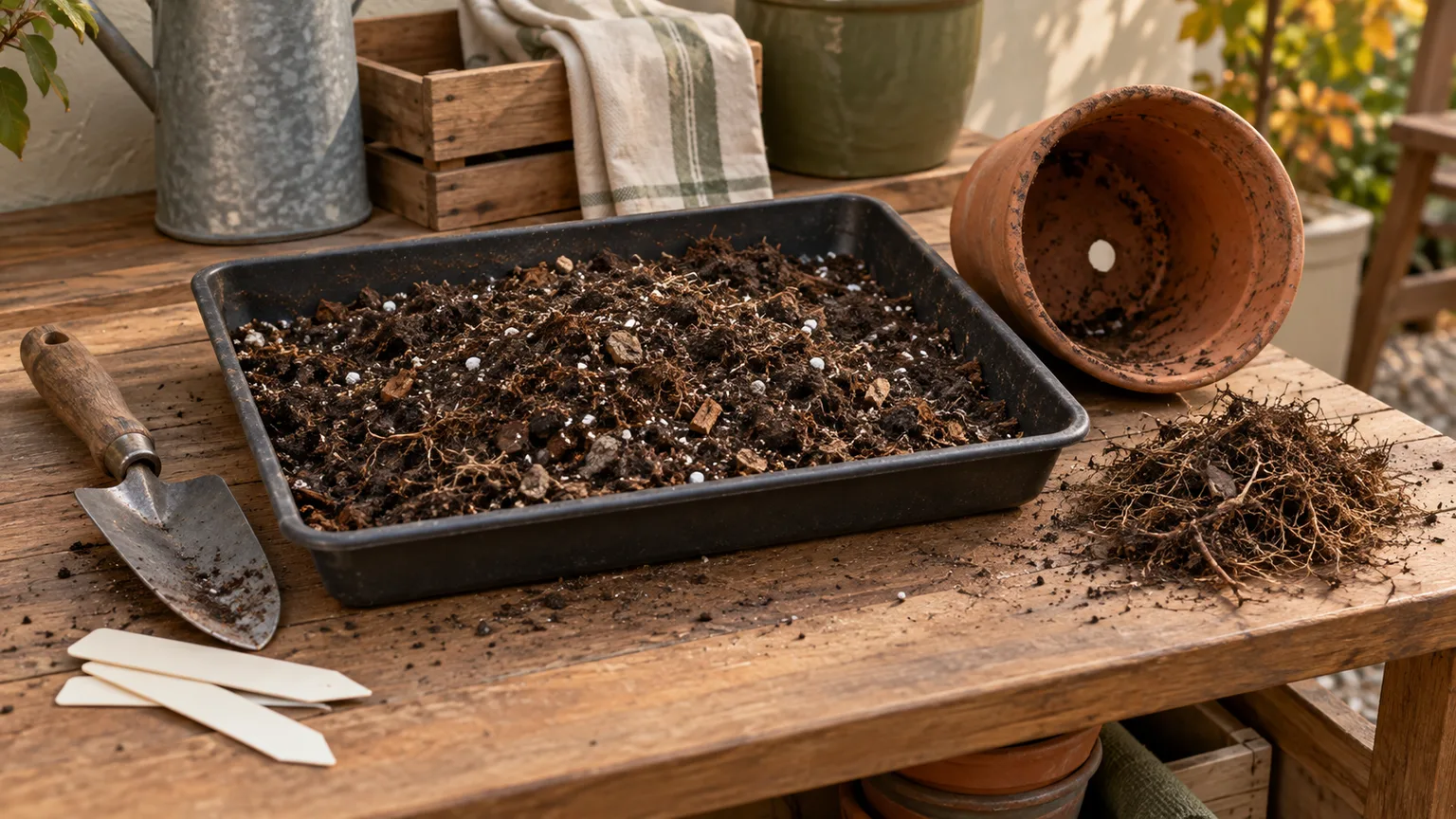
Tip a candidate batch onto a clean tray or sheet. Remove large roots, old stems, labels, and other debris, then gently break up the remaining clumps. The RHS guide to spent potting compost describes this preparation before reuse. In that U.K. guide, “potting compost” means the growing medium, not just material from a home compost pile.
Moisten a small sample in a draining spare pot and observe it before committing a valued plant. Does water soak through the mix, or run along a gap beside a dry block? Does the mixture remain an unmanageable dense lump? This check can expose an obvious physical problem; it cannot measure nutrients, pH, or disease status.
Adding fresh container mix can restore volume lost when you remove roots. There is no single mixing ratio that proves every used product suitable again: different ingredients and growing histories leave different material behind. If the old fraction stays dense and unworkable, choose a fresh mix for the next pot instead of adding amendments indefinitely.
Treat fertility as a separate decision
A mix can feel loose while having an uncertain nutrient supply. Conversely, adding fertilizer does not restore air space to collapsed material. New Hampshire Extension explains that growing media and nutrient sources need to be selected together; fertilizer availability also depends on the product and conditions. Read its guide to potting media and fertilizers.
Check whether the fresh mix you add already contains fertilizer. Use a product labeled for your crop and container, following its directions rather than assuming all old mix needs the same scoop. Keep track of what you added and when. The container feeding guide can help prevent overlapping products.
Give seedlings a fresh start
Reserve clean, new seed-starting medium for seed trays. University of Minnesota Extension specifically advises against reused mix for preventing damping off, a disease that can destroy young seedlings. Its damping-off guide also explains how used pots, media, and tools can carry the organisms involved.
That distinction matters when space is limited. Reusing a sound batch around an established outdoor transplant is a different decision from filling every tiny seed cell with it. Budget for the small quantity of fresh medium your seedlings need, even if you reuse suitable material elsewhere.
Clean the container before refilling it
Reusing the mix and cleaning the pot are separate jobs. Remove stuck-on roots and soil, wash the container, and follow a suitable disinfection procedure. Minnesota Extension explains that debris interferes with disinfection and that pots and tools can transfer plant disease. Its cleaning guide provides methods; follow the disinfectant label for dilution, contact time, rinsing, and safe handling. Do not add disinfectant to the potting mix.
Check drainage holes again after cleaning. If you set a batch aside for later, keep it labeled and protected from runoff and contamination rather than leaving an unidentified open heap. Before planting, reassess its condition; storage is not a treatment for a known pest or disease.
Know when reuse has done enough
Healthy but worn-out material can have another role in a garden or compost system. The RHS describes soil improvement, mulching, and compost-bin uses for spent medium. Review those options where they suit your space. For suspected diseased or infested material, get advice specific to the problem; do not assume spreading it somewhere else resolves it. Waste collection rules vary, so check your local service before filling a yard-waste bin.
You can measure the saving without claiming a better harvest. If a planter needs 20 quarts and 8 usable quarts remain after sorting, you need 12 more quarts to fill it: 40% of the volume is reused. That is a purchasing calculation, not a recommended recipe or proof that the mixture will perform well. Let the condition of the material decide whether those eight quarts belong in the pot.
Should I empty a healthy perennial herb every fall?
No. This sorting guide is for containers you have finished using or are already repotting. It is not a reason to disturb a healthy perennial on a fixed yearly schedule. Assess its growth, root space, and species-specific repotting needs separately.
Your next steps
0 of 5 steps checked · Saved on this device